Wood

From a historical perspective, books and woodwork are closely connected. Before the days of wood pulp paper, the tools of the book trades were made primarily of wood. From the vats used to pulp linen rag in the paper trade, the printing press with woodcut pictures and wood text blocks in the printing trade, to the stitching frame and presses used in the binding trade. To this day, many of the bookbinder’s tools are wooden. As a hand tool woodworker, this makes establishing a traditional hand bindery an exercise in experimental history.

I am embarking on a long-term and expansive set of projects in the book arts and bibliography as an experimental historian. The first phase is to get the workshop back to a hand tool wood shop. This involves scaling back in several areas, and building the infrastructure necessary for woodworking and book arts. The primary piece of infrastructure the rest of the shop is built around is the workbench.
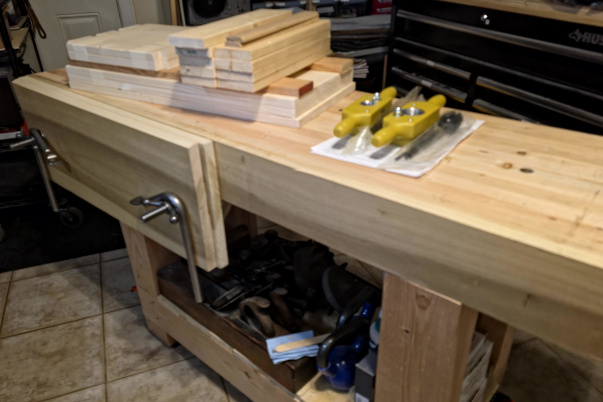
This joiner’s bench has a Moxon-style face vise with 24 inches between the screws. It is a relatively small bench at just 5 feet long and 17 inches wide. A typical joiner’s bench is 7 to 8 feet long; some are as long as 12 feet or more, and the typical joiner’s bench is 24 to 30 inches wide. This bench is made from Douglas Fir except for the face board and vise, which is Maple; it still weighs in at over 300 pounds unloaded. The workshop space available small, just over 150 square feet of usable space, this set the scale of the bench.

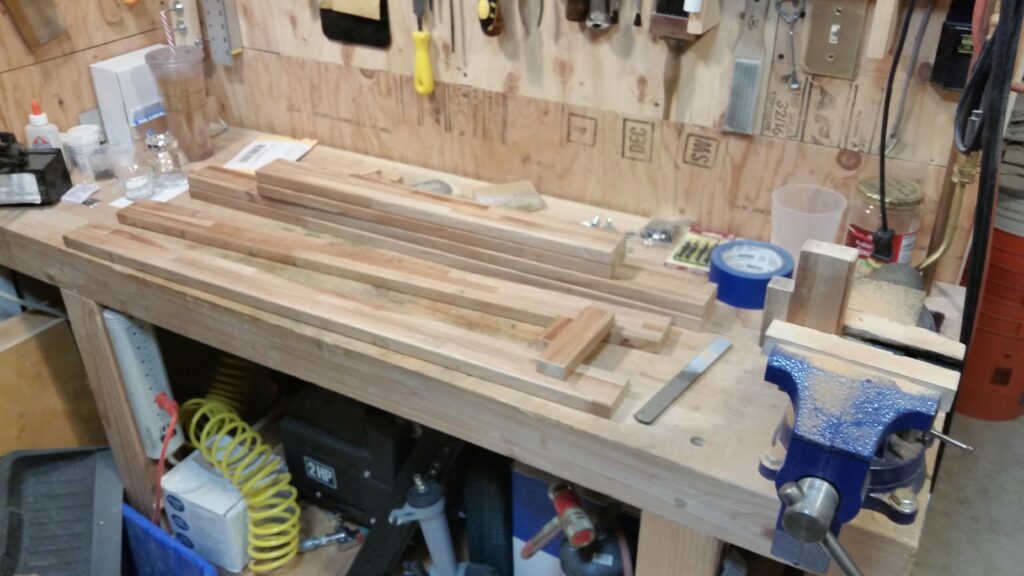
The second step is to remove all of the existing factory-made shop furniture and replace it with options that save floor space and are custom-designed for the space and the work at hand. The first project is a Dutch tool chest.1 The chest being built is a little different from the ones in the book in that this chest has two smaller detached chests under the double shelf version of the main tool chest. The one pictured below is the bottom chest with heavy-duty casters. This chest is 27 inches wide, 14 inches tall, and 12 inches deep. The middle chest is the pile of cut lumber sitting on the workbench and is 27 x 13 x 12. That build starts tomorrow. The top chest build should start within the next two weeks; its final dimensions have not yet been determined, but should come in around 27 x 31 x 12. The total height of the three should be between 60 and 65 inches.
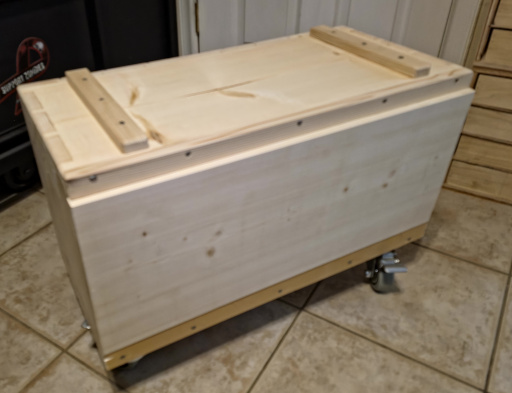
Once all three sections of the tool chest are completed, the factory-made furnishings can be emptied, either into the Dutch chest(s), or into temporary storage containers. The factory tool chest and rolling cabinet/bench will be sold, and the workshop’s cabinetry projects can begin.

The keen observer might have noticed the two wood tap and die sets on the workbench to the right of the lumber. These will be for a set of parallel projects. The 1-inch tap and die is for making the wooden screws for a stitching frame, and the 1 1/2 inch set is for the screws of a finishing vise and trimming frame. A small nipping press will also use a 1 1/2 inch screw. The factory-made wood tap and die sets were purchased for expediency. Down the project path, there will be a need for 2-inch, 4-inch, and 6-inch tap and die sets that will be shop-made. These large shop-made tap and die sets will be substantial projects in and of themselves. As one might expect, the projects requiring such large wood screws will be epic adventures.

Between the cabinetry and bookbinding workshop infrastructure projects, research will continue with an emphasis on bookbinding and bibliographically adjacent subjects as the workshop and bindery come into their own. The workspace and bindery are just the beginning. The journey will be filled with research and experimentation with materials, processes, and equipment. Along the way, conservation and preservation projects will be popping in from time to time, expanding opportunities. I have several 18th, 19th, and 20th century books and documents that need some love and should start making appearances this summer.

Things are beginning to take shape. It will be a very interesting and informative long and windy road. ‘Tis an adventure to my liking.

  1. Fitzpatrick, Megan. Dutch Tool Chests. Lost Art Press, 2004. ↩︎
Two Years and Ten Days

December 1, 2023, was the first post on this site when it was reimagined, and it has been a very busy two years. I started and completed my second master’s, applied and was accepted into a doctoral program, considered withdrawing from the doctoral program, applied for and was accepted into a third master’s program at Johns Hopkins, before deciding to recind my application to that program, and now, waiting for the start of the Spring term to re-engage with the doctoral program already underway. This reengagement was only possible after taking the fall term off to seriously reevaluate whether or not I would continue with this doctorate. In all honesty, the majority of the ‘drama’ has been between last July and September. However, it is official, I am enrolled in the spring term for my last academic class, HIUS 713 American Entrepreneurship Since 1900, and my first dissertation class, HIST 901 Doctoral History Research. I still have three Comprehensive Examination and Reading classes, HIUS 911 Early America, HIUS 912 Modern America, and HIEU 914 Modern Europe, before starting the formal dissertation phase, when I can consider myself a Doctoral Candidate and not just a Doctoral Student.

I have a wide range of interests, which has been both a blessing and a curse. On the positive side, it is relatively easy to shift from one subject to another and to learn new methods for presenting research. It also allows for a broader perspective to view subjects of research. This is great as a student in the academic setting, less so outside the academe. In a time where increasing specialization is the preferred mode, being a generalist can be disadvantageous. On the negative side, falling down a new rabbit hole is all too easy. It can be difficult at times to set the blinders and focus on one thing. This has been a contributing factor in not having fixed on a specific topic for the upcoming dissertation.

As a maker, my perspective on history is often guided by how things were done. Understanding how things were done and how the processes of doing have evolved can open up many avenues of inquiry in the historical record. At the core of making, for me at least, is knowing how things function and how they were made. Thus, my broad interests in machinery, transportation, communications, engineering, architecture, and design. Woodworking is one of the root trades for all of these categories. From Archimedes’ water screw to wind and water mills, wagons & carts, the printing press, early long-distance mechanical visual communications systems, and of course, the shelter and furnishings of our ancestors for thousands of years. Woodworking is also a self-supporting craft with tool-making historically being a key skill learned by the apprentice early on, making their own tools, chests, and benches, all being made in whole or in part from wood.

Before moving north from the San Francisco Bay Area to the Klamath Basin, a fair amount of time was spent building a workshop space that focused on bookbinding, restoring old tools, and woodworking.

One thing that did not make the move was the workbench. Proper positive workholding is one of the most important keys to effective and safe workshop processes in wood, metal, plastic, or any material. Without a proper workbench since moving, many cherished shop skills have languished in disuse. This week marks a reversal, a new heavy bench is now under construction.

The new bench is an interpretation of the traditional hand tool joiner’s bench. The list of projects that will rely on this bench includes the cabinetry and chests that will replace all of the current shop furniture, making specialized hand tools, making workholding & pressing tools for book repair and binding, and furniture making. Most of these projects will also have a historical component to them, particularly the tool and furniture projects.

One of the concepts under consideration for a dissertation includes developing and employing a framework for Experimental History, using period-appropriate tools and methods to replicate an object of importance to a specific line of research inquiry, whether as an artifact or process. If this concept is to be included in the upcoming dissertation, there will most certainly be a need for tool and pattern making, as well as the construction of the object of inquiry itself. This requires the re-establishment of a working shop, the joiner’s bench being the anchor of the shop.

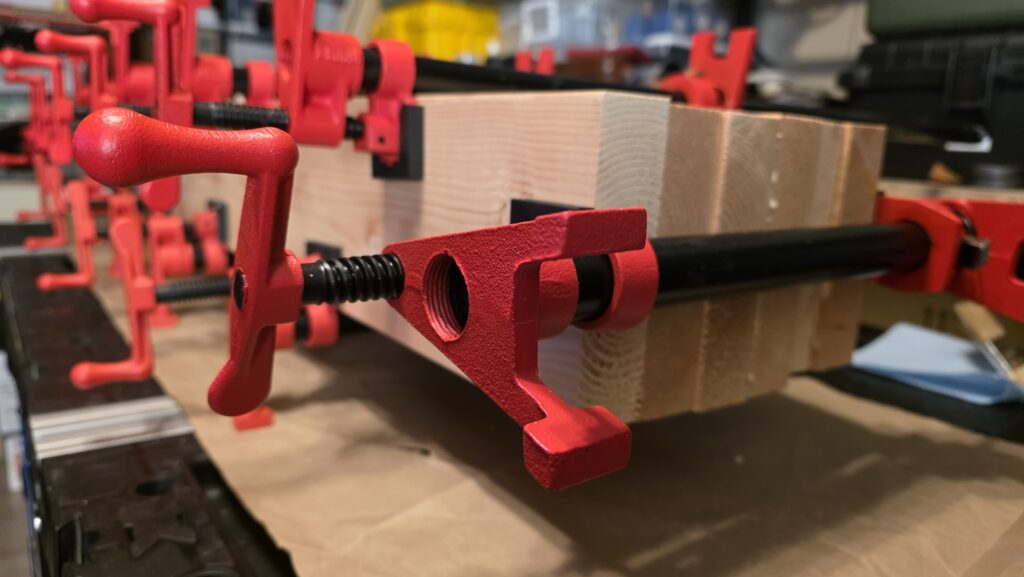
Between shop projects and the possibility of employing Experimental History, the urgency of getting a working hand tool shop up and running is high. To that end, the materials for the bench were acclimating in the shop last week: (10) 2″ x 8″ x 10′ nominal fir construction lumber, and a 6/4 – 14″ x 12′ maple slab. Two days ago, the materials were milled down from nominal lumber to near-dimensional boards, and yesterday, glue-ups started for the major components in rough sizes: (4) legs 5″ x 4″ x 36″, (4) stretchers 5″ x 3″ x 48″, and (1) bench top 5″ x 20″ x 60″. By the end of next week, all of the glue-ups should be done, and final dimensioning can begin. The target size for the bench is a 5″ thick bench top, 20″ deep, 60″ wide, standing 32″ tall, with a 1″ thick fir shelf about 7″ from the floor, inset into the stretchers. The draw-bore mortise and tenon joinery should be all marked out and cut next weekend over the winter solstice. Installation of the mapleface, back, and ends, along with a Moxon-style face vise, tail wagon-vise, the hold-fast and dog holes, and finishing should be done over Christmas week. The plan is to be finished and dressed by January 1st, so work can begin with the new year.