
Wood

From a historical perspective, books and woodwork are closely connected. Before the days of wood pulp paper, the tools of the book trades were made primarily of wood. From the vats used to pulp linen rag in the paper trade, the printing press with woodcut pictures and wood text blocks in the printing trade, to the stitching frame and presses used in the binding trade. To this day, many of the bookbinder’s tools are wooden. As a hand tool woodworker, this makes establishing a traditional hand bindery an exercise in experimental history.

I am embarking on a long-term and expansive set of projects in the book arts and bibliography as an experimental historian. The first phase is to get the workshop back to a hand tool wood shop. This involves scaling back in several areas, and building the infrastructure necessary for woodworking and book arts. The primary piece of infrastructure the rest of the shop is built around is the workbench.
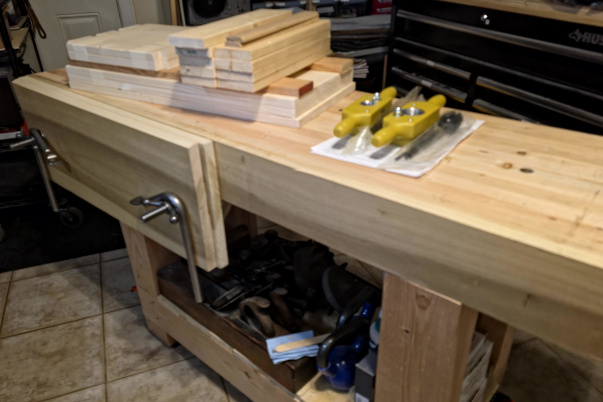
This joiner’s bench has a Moxon-style face vise with 24 inches between the screws. It is a relatively small bench at just 5 feet long and 17 inches wide. A typical joiner’s bench is 7 to 8 feet long; some are as long as 12 feet or more, and the typical joiner’s bench is 24 to 30 inches wide. This bench is made from Douglas Fir except for the face board and vise, which is Maple; it still weighs in at over 300 pounds unloaded. The workshop space available is small, just over 150 square feet of usable space, this set the scale of the bench.

The second step is to remove all of the existing factory-made shop furniture and replace it with options that save floor space and are custom-designed for the space and the work at hand. The first project is a Dutch tool chest.1 The chest being built is a little different from the ones in the book in that this chest has two smaller detached chests under the double shelf version of the main tool chest. The one pictured below is the bottom chest with heavy-duty casters. This chest is 27 inches wide, 14 inches tall, and 12 inches deep. The middle chest is the pile of cut lumber sitting on the workbench and is 27 x 13 x 12. That build starts tomorrow. The top chest build should start within the next two weeks; its final dimensions have not yet been determined, but should come in around 27 x 31 x 12. The total height of the three should be between 60 and 65 inches.
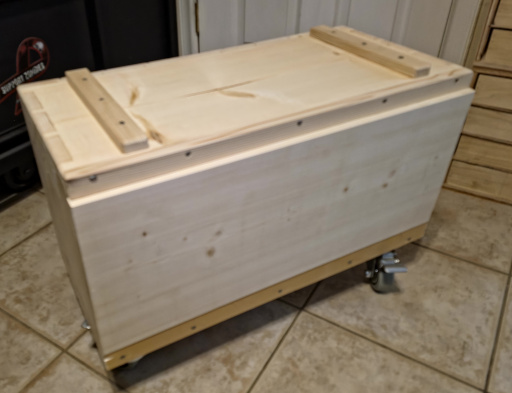
Once all three sections of the tool chest are completed, the factory-made furnishings can be emptied, either into the Dutch chest(s), or into temporary storage containers. The factory tool chest and rolling cabinet/bench will be sold, and the workshop’s cabinetry projects can begin.

The keen observer might have noticed the two wood tap and die sets on the workbench to the right of the lumber. These will be for a set of parallel projects. The 1-inch tap and die is for making the wooden screws for a stitching frame, and the 1 1/2 inch set is for the screws of a finishing vise and trimming frame. A small nipping press will also use a 1 1/2 inch screw. The factory-made wood tap and die sets were purchased for expediency. Down the project path, there will be a need for 2-inch, 4-inch, and 6-inch tap and die sets that will be shop-made. These large shop-made tap and die sets will be substantial projects in and of themselves. As one might expect, the projects requiring such large wood screws will be epic adventures.

Between the cabinetry and bookbinding workshop infrastructure projects, research will continue with an emphasis on bookbinding and bibliographically adjacent subjects as the workshop and bindery come into their own. The workspace and bindery are just the beginning. The journey will be filled with research and experimentation with materials, processes, and equipment. Along the way, conservation and preservation projects will be popping in from time to time, expanding opportunities. I have several 18th, 19th, and 20th century books and documents that need some love and should start making appearances this summer.

Things are beginning to take shape. It will be a very interesting and informative long and windy road. ‘Tis an adventure to my liking.

  1. Fitzpatrick, Megan. Dutch Tool Chests. Lost Art Press, 2004. ↩︎

Intentionality II

I applied to Johns Hopkins on July 7th and was accepted on the 17th. My digital presence at the university was processed at a rapid pace, and I had been engrossed in all the preparatory university informational and program-specific reading. I was also focused on completing all of the policy-related training for new students. This occupied the better portion of the week after I was accepted. Then they started to creep into my thoughts, questions.

  • What am I doing?
  • Why am I doing this?
  • Do I need to do this?
  • Does this get me any closer to my goals?
  • How will this affect me in ways I haven’t considered?
  • Why didn’t I consider these questions before now?

This all put me into a contemplative state of mind. I wanted answers to these questions, and more kept coming, so I stopped the new student reading and training and took the afternoon to dig into these questions and assess where this was going. I’ll answer the last question above first because it affects all of the others. I wanted a reputable, secular school on my academic record. It was in many ways a mia culpa for supporting an institution as long as I had. Understanding that motivation and accepting it as truth made it much easier to see the other truths that were to come from this self-reflection.

Truth One. I’m not in my 20s or 30s anymore. That may seem obvious, but honestly, despite the constantly aching knees and restless sleep, I usually feel much younger than I am. I believe that is what has carried me through my academic pursuits of the last seven years.

Truth Two. I don’t want to retire in my 80s. Yikes. At best, I have maybe 20-25 years of useful “work” in me. I would like most of that time to be in a hand tool woodshop or on the water, not worrying about pleasing my 30-year-old boss. Yes, it sounds like a grumpy old guy, and in many ways it is, but it is founded in a lifetime of diverse experience.

Truth Three. I don’t want to be a teacher. It is not that I dislike teaching. On the contrary, I love teaching. I don’t want to teach in the environment created by the current administration. I am also not a fan of the internal politics of the academy. I could see myself teaching part-time as an adjunct, but I would be more fulfilled working on educational programs at a museum. This is where it sunk in that I didn’t want to be a professor.

ETA I have since reconsidered this position to some extent, I do want to teach.

Truth Four. If I am not teaching at the university level, I don’t need a Ph.D. When I started the Ph.D. path, I wanted to teach at the university level. I have to admit, though, that part of the attraction was vanity. To deny that would be untruthful, and this exercise is about truth.

ETA Again, I have reconsidered this position. I do want to teach at the university level; thus, I have reengaged with the doctoral program, taking only one semester off.

Truth Five. I have two master’s degrees. Will a third get me closer to my goals? The short answer is, no, it won’t. In many ways, this answer sucks. I am truly interested in the Cultural Heritage Management program and would rather not withdraw from it. I am so grateful and feel truly blessed that I got into the program. If things were not as they are, I would likely stay in the program just for the edification and enjoyment. Things as they are, I am withdrawing.

Truth Six. My academic career has come to its conclusion. This sounds rather final, almost dark. However, the fact is, I will not be in the academe in a formal sense. I will surely engage with it and may even actively participate in the academe in the future. For now, at least, I am not a student, an instructor, or affiliated with a university. While I am a little sad about that, it is what it is, and I am okay with that.

ETA when I posted this, by academic career, I meant formal academics. However, this too has changed as I return to the doctoral program.

Truth Seven. It’s time to put all of this training to good use. Having taken instruction out of the mix, that leaves public history. There are a lot of directions a historian or public historian can go. Most often, we think of museums and parks, and I had hoped to go in the museum direction. Where we are, geographically, this isn’t a viable direction. Engaging as an independent contractor with governments, businesses, and organizations is the most viable path.

ETA my conciderations here remain. In light of some recent events, I am even more inclined to look for non-local alternatives.

Truth Eight. If I am going to find traditional, institutional employment, it won’t be where we are geographically. There are many parts of the country where a public historian can find work far more easily than in Oregon.

Truth Nine. Doing history and or public history independently is going to require strong self-motivation skills. Like any independent contractor, it’s all on you to make things happen. Fortunately, I have a lot of experience in this.

Truth Ten. Assuming I pursue doing history/public history as an independent contractor, I have a lot of planning and development work to do.

These realizations are split into two tenses, past and present. I needed to see and acknowledge the first six for what they are, so I could process seven on. There is still a lot to do, an understatement to be sure, but it is time to move forward.

ETA I chose to take the fall term off to reflect more on these truths. Very little has changed in the bigger picture. The main change was the decision to return to the doctoral program and finish what I started. My decision is not based on “I’m over half done, I should finish this.” I tuely do want to earn my doctorate in history. While finishing what I started does play a small roll in my decision, it is a very small role. I am committed to this path.

updated December 11, 2025