Blog

World War I, Newspapers, and the CPI


By: Jonathan Wanzer ORCiD 0009-0004-9275-7410
Submitted on: January 30, 2026
Submitted to: Dr. Cervantez – Liberty University
Course: HIUS 713 American Entrepreneurship Since 1900
Chicago Citation:
Wanzer, Jonathan. “World War I, Newspapers, and the CPI.” Historical Interpretations (blog). January 30, 2026. http://wanzer.org/2026/01/world-war-i-newspapers-and-the-cpi/.

Abstract
This post provides a brief history of the newspaper industry. It covers industry growth through the Gilded Age. It introduces George Creel and his relationship with Woodrow Wilson. The creation of the Committee on Public Information. How CPI and Creel disseminated information and sold America on joining the war in Europe. It concludes with the industry recovering post-war.


Postbellum America was experiencing dramatic changes in all areas of life. The newspaper industry was no different; the period from 1830 to 1930 is often referred to as the Golden Age of American newspapers, and many of the industry’s greatest changes in this period took place between 1880 and 1900. Technology improvements introduced mass production presses, faster communication, and broader reach, all of which served the industry’s need to expand and interconnect. The introduction of the penny-press publishing model, the development and rapid growth of newspaper chains, and the consolidation of chains into empires, exemplified by Joseph Pulitzer and William Randolph Hearst, all contributed to the industry’s expansion in this period. Other models were also taking form in this period, such as yellow journalism. Sensationalism, hyperbole, and exaggeration were regular features of the newspaper industry. At the same time, professionalization in journalism and muckraking became growing parts of the industry.

Sensationalism, hyperbole, and exaggeration have always been part of the press. What distinguishes this period is the motivation behind it. While most newspapers had been funded by political parties before this time, they were now commercial interests tied only to the owner’s political interests. Newspapers were just as likely to attack either party if they could sell more papers. If money was coming in, editors would have greater latitude. Professionalism was starting to take root, bringing about the muckrakers, what we would now call investigative journalists. These muckrakers were also given some freedom in whom they went after, especially if it was likely to sell more papers. While politics was still a motivating factor in the media, the economics of the business were of greater concern. The media’s acceptance of sensationalism and hyperbole would set the stage for its usefulness in propaganda dissemination.

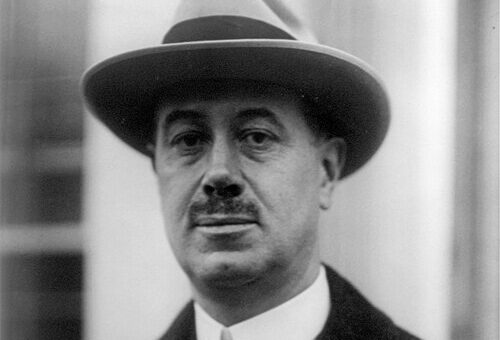
George Creel (1876-1953) began his career in the press in 1896 at the Kansas City World as a reporter. He would work at many newspapers and own several before his involvement with Woodrow Wilson’s (1886-1924) re-election campaign in 1916. He had been a Wilson supporter for a while when he met Wilson in 1912, and they had had several conversations on politics and the press before 1916. As a newsman, Creel was well-versed in advertising and the nascent practice of managing public perceptions, which we now recognize as the field of Public Relations. Creel and Wilson would have several conversations during the 1916 campaign where Creel promoted a way to sell the American people on joining the war in Europe. A key part of this would involve the media distribution channel with the greatest reach, newspapers. Several of Wilson’s cabinet members proposed a full media blackout and imposed censorship. Creel advised Wilson, proposing no blackout or censorship, instead, the government would create a clearinghouse that would clear and disseminate government information and requests for information. The press would be expected to sign an agreement that they would submit any articles even tangentially related to the war effort for clearance, and in exchange, they would have a firehose of information to drink from, all pre-cleared through this clearinghouse. With only a few dissenters, mostly in the War Department, Creel’s plan was accepted, and by Executive Order 2594, the Committee on Public Information was formed on April 13, 1917, just seven days after America joined the war in Europe.

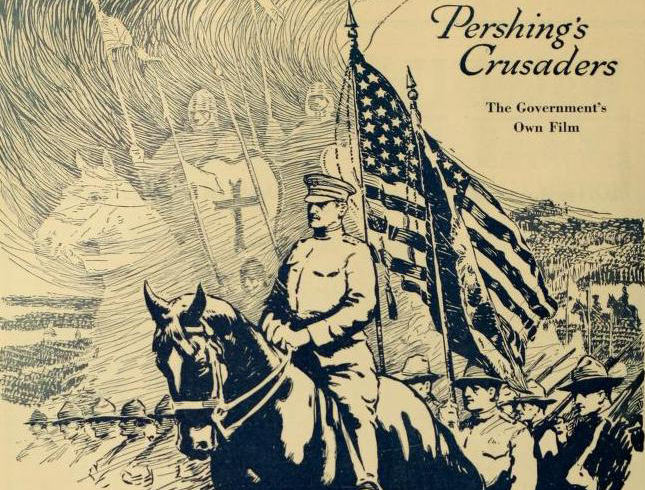
The Committee on Public Information (CPI) had two primary responsibilities: to manage and clear for dissemination all information outside of military channels and to the public on the United States involvement in the war in Europe, and to sell the American population on the war. In two weeks after the establishment of the CPI, George Creel had reached out to his media contacts, establishing contact with newspaper owners and editors across the nation to get them to sign agreements with the CPI to clear all internally generated stories. Many of the owners and editors were skeptical about the “article clearance” being just another form of censorship, and they weren’t sure that the CPI could serve so many outlets. By the end of May, a large majority of newspapers had signed the agreement, and the CPI was generating hundreds of articles per day. As the CPI expanded in the weeks to come, it established regional offices around the country to clear articles, provide pre-cleared articles, and generate pre-cleared articles of local and regional interest. In just a couple of months, the CPI was generating thousands of articles a day. They were so successful that the CPI’s scope was expanded on September 25, 1917, to establish divisions for pictures, films, and other publications.

Early in the CPI’s existence, it was outputting thousands of columns of news per day, and it was by far the largest news organization in the country. The content it produced was for the end consumers of news, the American people. It could have become a state-run news organization, which was recognized by the media moguls and small paper owners of the day. They had a few options, but the only option that would not negatively affect their bottom line was to work with the CPI. CPI provided massive amounts of content that could effectively go straight to typesetting. They also had a large variety of topics to choose from. A paper could produce an entire issue from CPI-generated columns alone. Most papers continued to generate content internally, but the volume was considerably reduced, subsequently reducing newsroom costs, all while increasing circulation to wartime readers. Most businesses that bought ad space continued to advertise, though they tended to lean towards patriotic themes in their advertising. After the war, the CPI was abolished in August 1919. At this time, the Associated Press, which was founded in 1846, took its pre-CPI place as the largest news gathering organization in America.

Sources

  • Axelrod, Alan. Selling the Great War: The Making of American Propaganda. Palgrave Macmillan, 2009.
  • Creel, George. How We Advertised America: The First Telling of the Amazing Story of the Committee on Public Information That Carried the Gospel of Americanism to Every Corner of the Globe. Harper & Brothers, 1920.
  • Creel, George. Rebel at Large: Recollections of Fifty Crowded Years. G.P. Putnam’s Sons, 1947.
  • Kingsbury, Celia Malone. For Home and Country: World War I Propaganda on the Home Front. University of Nebraska Press, 2010.
  • Schudson, Michael. Discovering the News: A Social History of American Newspapers. Basic Books, 1978.
  • Smythe, Ted Curtis. The Gilded Age Press, 1865-1900. Praeger, 2003.

A Soft Spot for Newspapers

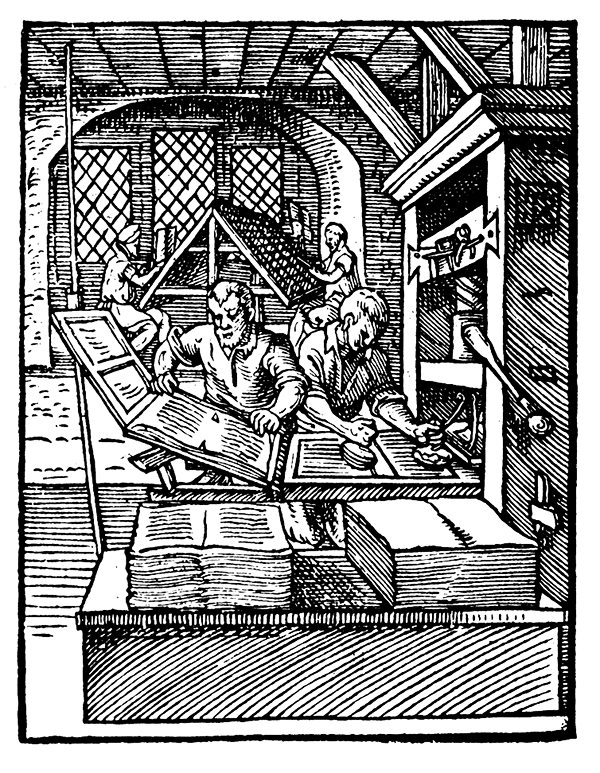
I have always had an affinity for newspapers, the physical medium, more so than the content. In many ways, it is like my affinity for books, the physicality of the medium. As long as I can remember, I have been interested in manual printing presses and the early small-run automated presses of the late 18th and early 19th centuries. I am not much of a journalist, but I have done ad and magazine design work as well as photography, along with the digital processing of text and visual components. Over the last year or so, my affinity for the idyllic small-town press has grown—the kind of paper you might find in Andy Griffith’s Mayberry.

My research on propaganda has me doing background on the history of newspapers in America. The two have been close companions since the introduction of broadsheet media, soon after the invention of the printing press. America’s entire history includes propaganda in newspapers from the colonial period to the present. I have an assignment due Sunday on how the turn of the 20th-century newspaper industry was affected in a business sense by the Committee on Public Information’s engagement with the press in both selling America on the war and disseminating information during the war.

One of the first illusions shattered by this research was the idea of the idyllic small-town paper. When they did exist, they were likely a political or special-interest paper from around 1800-1880. By the 1900s, mass-market press, muckrakers, and yellow journalism were already well established. The press lords began to dominate the newspaper industry shortly after the penny-press movement started in the 1830s. Their reign would continue through the Gilded Age, well into the 1930s.

Aside from bringing historic reality into focus, this research has furthered my interest in the restoration of manual and semi-manual presses from the 19th and early 20th centuries. It is also furthering my interest in producing limited press runs of broadsides. What has been added to my list of potential interests is journalism. Journalism from the perspective of that idyllic small-town newspaper, or just maybe, some contemporary journalism flavored with a bit of sass and humor in the spirit of the younger Franklin brother in Philadelphia.

Spring Term 2026

Last academic class! The B-subterm is about to start, and I am taking my last academic class before venturing into a doctoral dissertation. The class is HIUS 713 American Entrepreneurship Since 1900. It’s not a class that, on the outset, ‘sparks joy.’ Thank you, Marie Kondo. While I do have an interest in economics and how it impacts historical events, it is essentially always involved in historical events in some way. It is not a topic I want to burn a lot of cycles on. I generally acknowledge its position as a factor and how/why it is important to acknowledge, but that’s about it. I am not an economist and have no desire to become one. I am also not in business in a way. When it comes to business and economic theory, I am only interested in the micro level with small businesses and local community economics. I hold great disdain for ‘big business’ and the centralization of business sectors, especially when it comes to finance, the food system, and infrastructure. From my perspective, centralization and the scale of ‘big business’ are the causes of many, if not most, of the problems America faces today. Especially things revolving around the topics of wealth disparity, poverty, inequity, and ignorance.

All of that having been said, I have some thoughts on how I might link entrepreneurialism to my research in propaganda and extremism. Anyone with ideas similar to those expressed in the first paragraph is likely thinking, ‘yeah, no duh. Big business linked to propaganda and extremism, there’s a stretch.’ I could point to Public Relations, Marketing, and Advertising as they are, and cite article after article on market and consumer manipulation, but that’s not interesting for me, and I don’t want to spend my time boring myself. To get the creative juices flowing, I am thinking mass media, its commercial interests, and the conflict of interest between shareholders and journalistic responsibility and integrity. I don’t know just yet if this is the path I will take, but it is a frontrunner.

The D-subterm class is HIST 901 Doctoral History Research. The course summary says “instruction on methodological and interpretive approaches appropriate for doctoral research in the discipline of History.” It is the first class in the dissertation process. I still need to complete my comprehensive reading and examination classes, but this is where the formal discussion on dissertation topics begins. I believe this is also where the dissertation advisor is assigned, and the reading selections for comps are conformed to complement the dissertation topic.

After the three comps classes, and before the formal dissertation classes, there is HIST 890 Historiographic Research, which is also a part of the dissertation phase, and focuses on the bibliography and historiography for the dissertation. After HIST 890, I will be considered ABD and officially a Doctoral Candidate.

  • HIUS 713 American Entrepreneurship Since 1900 (Spring 2026 B)

* Dissertation classes are considered J-Term, and the dissertation advisor/committee decides when the candidate moves from one dissertation class to the next. They are not tied to the calendar like other classes.

I am excited to be moving forward. It feels really close to the end of the process, and at the same time, two more years seems an interminably long time. History, like life, is full of dicotomies such as these. I am still a touch timorous about the comprehensives. The idea of having a huge chunk of reading followed by an essay exam and an oral exam is daunting. I am not a fast reader, and while I have a high comprehension rate, my recall of dates and names can be spotty. I remember stories and concepts well, even intricate ones, and I can convey them well. Specifics, on the other hand, are more difficult. That’s why I take copious notes.

To close this entry, I wanted to share a little about my goals for the year. These are not resolutions, I am not placing any pressure on myself to complete them. They are things I would like to do, as time permits:

  • Family: Find ways to spend more downtime or shared-time with family
  • School: Hold a steady pace moving forward, and take weekends off
  • Work: Keep work as-is, no additional responsibilities or obligations
  • Hobbies: Spend time woodworking every week
  • Linguistics: Learn Old English

I recognise that learning Old English to the level I would like will be time-consuming and take more than one year. My goal for this year is to be able to start reading Bēowulf without having to look up every other word. I do have a long-term linguistics plan in mind: Old English followed by Old Norse to begin with. If I do well with OE and make good headway with ON, I may expand on this list. If I don’t, well, that’s okay too. Even though I am long in the tooth, I would like to learn more languages, most of which are ancient too. We will see how it goes.

AI generated with Adobe Firefly. Prompt: In the style of Dutch masters, an old man, white hair and beard, a professor, writing in a journal with fountain pen, 1914 American cloths, sitting at large oak desk. Desk illuminated by Tiffany desk lamp, 3/4 full bottle of burbon, rocks-glass of burbon on desk. Room is a dimmly lit study with bookcases, lots of old books, a large floor stand globe, low stacks of books on desk and floor, a tall window with the image of thomas aquinas in stained glass. Entire room is visibal.

Low-Background AI

Low-Background Steel AI is a term used by John Graham-Cumming[1] that draws from the terminology and practice of the recovery of steel manufactured before the Trinity nuclear tests that began in 1945. The recovery of pre-test steel was necessary because the known background radiation present in steel manufactured before 1945 was a relative constant. After Trinity testing began, the background radiation in steel was contaminated on a worldwide scale. Developing and manufacturing sensitive radiological test equipment required Low-Background Steel with predictable radiological properties. Equipment manufactured with post-Trinity steel would be unreliable due to the unstable background radiation. This condition persisted throughout the Cold War period and beyond. Some time, well after the Limited Nuclear Test Ban Treaty of 1963 had been signed, background radiation levels began to normalize, making the practice unnecessary around 2008. There is a correlation between the Trinity tests and the advent of AI in November 2022. Since then, text, photographic, and video sources have become contaminated by AI. The proliferation of “AI slop”[2] has been accelerating at an alarming pace ever since and can be readily seen on social media platforms across the internet, and is not limited to social media. Thus, Low Background AI is material created before November 2022, when content was human created.

Cash Grab or Propaganda

This is not the first time concerns like those posed by post Low-Background AI have arisen. Leaders of political and religious movements have often set out to intentionally purge human created material that presented an ideological opposition to their movements throughout human history. In fact, it has been a common trait in individuals and movements that not only seek victory, they also seek to obliterate the memory of their perceived enemy, to change history, to silence challenges to their version of history, and to commit cultural genocide. From the burning of the Temple of Artemis by Herostratus (356 BCE), the British burning of Benin City (1897), Mao’s destruction of ancient temples (1966-1976), Nazi destruction of Jewish heritage and art (1933-1945), to the modern destruction of heritage sites at Palmyra and Nimrud by ISIS (2015). The difference between these past atrocities and AI lies in scope, speed, and intention. The scope is worldwide and in all accessible mediums. The speed is frighteningly fast and without precedent. AI slop is on track to outpace human submissions on several platforms in a short time. According to The Guardian,[3] over 20% of the videos YouTube’s algorithm shows to new users is AI slop. “The video-editing company Kapwing surveyed 15,000 of the world’s most popular YouTube channels – the top 100 in every country – and found that 278 of them contain only AI slop.”[4] Which brings us to the third difference, intention. While much of the AI-generated slop is purely for profit,[5] there are other motivators. In today’s mixed-slope market, money, attention, and ideology are the dominant motivators. Slop is used extensively in disinformation and propaganda campaigns on social media because it is a fast, easy, and cheap way to get agenda messaging into the wild[6] with little attention being paid to dispute claims, and there is the sheer volume of slop being pushed, saturation of the message is all but guaranteed, regardless of fact-checking and follow-up refutation.

Ready for Primetime?

OpenAI flipped the switch on April 10, 2025, turning on ChatGPT’s ambient memory training model, placing you, the user, as part of the AI’s training by remembering personal details about you, the user, to predict how you will act in your use of the AI. This goes well beyond using generative AI tools to help edit a photo or video that you create, or searching for synonyms, or rewriting a particular phrase in a manuscript. It sets up the conditions for an unrestrained, active learning environment. When AI has the opportunity to choose its learning data, is unrestrained, or is given an unsuitable dataset for learning, the results have not been good. From ChatGPT being involved in murder and suicide cases, Replit rewriting code and lying about it, Grok becoming a white supremacist, MyCity encouraging illegal activities, ChatGPT AI “authors” writing factually incorrect articles, and a wide range of reports where AI agents created or referenced data that never existed, it is clear that there are significant issues with the technology.[7] This begs the question, why? Why are tech companies so invested in forcing AI on the general population? What is the motivation for AI being used for content generation? What is the justification for providing such powerful tools to trolls and provocateurs?

A Reckoning

There is a bright spot on the horizon. AI slop has been pushed so hard by opportunistic revenue generators and ideological provocateurs that a majority of potential consumers on social media have grown tired of AI’s proliferation and are paying less attention to AI-generated content. To be sure, there are still niche markets for this kind of ideological propaganda. In conspiracy theory spaces, AI materials are consumed voraciously, but these are much smaller consumer bases. The general population’s attention, though initially captured, seems to be developing a resistance to further inculcation.[8] The backlash has already begun. Conversation on AI-generated content proliferates public discourse online and off, including concerns over intellectual property rights, and the dangers and ease of the rapid deployment of disinformation. Somewhat in line with the Skynet discussion of physical dangers posed by autonomous AI systems,[9] there are tangible issues with AI, cognitive offloading, and potential for cognitive decline in humans are major concerns. Sat Singh proposes in his TEDx presentation[10] that there is something we can do to prevent cognitive decline due to AI: Resist Unthinking, or resist offloading our thinking responsibilities, and spend time actively building cognitive skills. When given the option, decline to use AI tools to create content, or any other task you can do yourself.

What This Means for History and Historians

Historians must recognize that this is a period of unreliable sources. Until the long-term effects of the early age of AI are known and understood, all content and information created in this time should be considered unreliable as fact or as an account of events for future historians producing historical content of this period. Without clear provenance, provable data integrity of photographs, audio, and video, without eyewitness documentation, the ability to discern fact from AI fiction is not possible. Historians and archivists in this period must pay particular attention to including metadata and documentation on the authenticity of their work and their sources. Exhaustive sourcing of anything produced in this period must be a primary concern if the facts and truthful accounts of this period are to make the journey into the future. Historians face an unprecedented task; we know, without reservation, our data will and rightfully should be suspect. We must include the tools future historians will need to sus out fact from AI fiction.


[1] Ben J. Edwards, “Scientists once hoarded pre-nuclear steel: now we’re hoarding pre-AI content,” ARS Technica, June 10, 2025, https://arstechnica.com/ai/2025/06/why-one-man-is-archiving-human-made-content-from-before-the-ai-explosion/.

[2] Anna Furman, “Merriam-Webster’s word of the year for 2025 is AI ‘slop’,” PBS News, December 15, 2025, https://www.pbs.org/newshour/nation/merriam-websters-word-of-the-year-for-2025-is-ais-slop.

[3] Aisha Down, “More than 20% of videos shown to new YouTube users are ‘AI slop’, study finds,” The Guardian, December 27, 2025, https://www.theguardian.com/technology/2025/dec/27/more-than-20-of-videos-shown-to-new-youtube-users-are-ai-slop-study-finds.

[4] Emphasis added by author

[5] Ann-Derrick Gaillot and Anna Amarotti, “What the Rise of AI Slop Means for Marketers,” Meltwater, November 27, 2025, https://www.meltwater.com/en/blog/ai-slop-consumer-sentiment-social-listening-analysis.

[6] Kevin Collier, “Large online propaganda campaigns are flooding the internet with ‘AI slop,’ researchers say: Researchers at Graphika say that online propaganda campaigns have flooded the internet with low-quality, AI-generated content,” NBC News, November 19, 2025, https://www.nbcnews.com/tech/security/online-propaganda-campaigns-are-using-ai-slop-researchers-say-rcna244618.

[7] Thor Olavsrud, “10 famous AI disasters,” CIO, December 17, 2025, https://www.cio.com/article/190888/5-famous-analytics-and-ai-disasters.html.

[8] Chase Varga, “AI Slop: When the Internet Drowns in Synthetic Junk,” ListenFirst, September 9, 2025, https://www.listenfirstmedia.com/ai-slop/.

[9] Michael LaBossiere, “Sci-Fi AI: Skynet Threat,” Florida Agricultural and Mechanical University, Accessed December 30, 2025, https://www.famu.edu/academics/cypi/hewlett-cyber-policy-institute-blog/sci-fi-ai-skynet-threat.php.

[10] Sat Singh, “AI, Skynet, and why humans are losing the battle,” TEDx Rancho Mirage, September 4, 2025, https://www.youtube.com/watch?v=oYG2kFC2_D4.

The featured image for this article was AI generated using Adobe Firefly.
The prompt was “A photo-realistic visual representation of an AI writing a non-fiction book about the dangers of using AI to create propaganda disinformation.”

Two Years and Ten Days

December 1, 2023, was the first post on this site when it was reimagined, and it has been a very busy two years. I started and completed my second master’s, applied and was accepted into a doctoral program, considered withdrawing from the doctoral program, applied for and was accepted into a third master’s program at Johns Hopkins, before deciding to recind my application to that program, and now, waiting for the start of the Spring term to re-engage with the doctoral program already underway. This reengagement was only possible after taking the fall term off to seriously reevaluate whether or not I would continue with this doctorate. In all honesty, the majority of the ‘drama’ has been between last July and September. However, it is official, I am enrolled in the spring term for my last academic class, HIUS 713 American Entrepreneurship Since 1900, and my first dissertation class, HIST 901 Doctoral History Research. I still have three Comprehensive Examination and Reading classes, HIUS 911 Early America, HIUS 912 Modern America, and HIEU 914 Modern Europe, before starting the formal dissertation phase, when I can consider myself a Doctoral Candidate and not just a Doctoral Student.

I have a wide range of interests, which has been both a blessing and a curse. On the positive side, it is relatively easy to shift from one subject to another and to learn new methods for presenting research. It also allows for a broader perspective to view subjects of research. This is great as a student in the academic setting, less so outside the academe. In a time where increasing specialization is the preferred mode, being a generalist can be disadvantageous. On the negative side, falling down a new rabbit hole is all too easy. It can be difficult at times to set the blinders and focus on one thing. This has been a contributing factor in not having fixed on a specific topic for the upcoming dissertation.

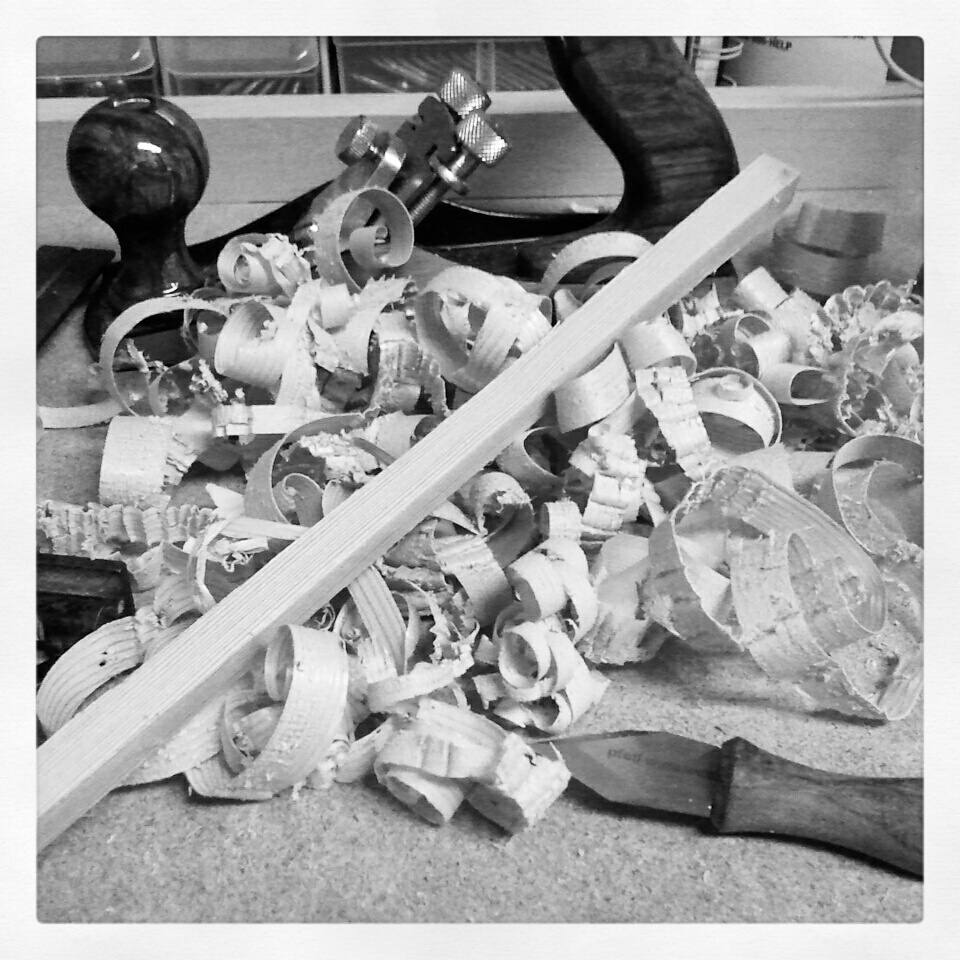
As a maker, my perspective on history is often guided by how things were done. Understanding how things were done and how the processes of doing have evolved can open up many avenues of inquiry in the historical record. At the core of making, for me at least, is knowing how things function and how they were made. Thus, my broad interests in machinery, transportation, communications, engineering, architecture, and design. Woodworking is one of the root trades for all of these categories. From Archimedes’ water screw to wind and water mills, wagons & carts, the printing press, early long-distance mechanical visual communications systems, and of course, the shelter and furnishings of our ancestors for thousands of years. Woodworking is also a self-supporting craft with tool-making historically being a key skill learned by the apprentice early on, making their own tools, chests, and benches, all being made in whole or in part from wood.

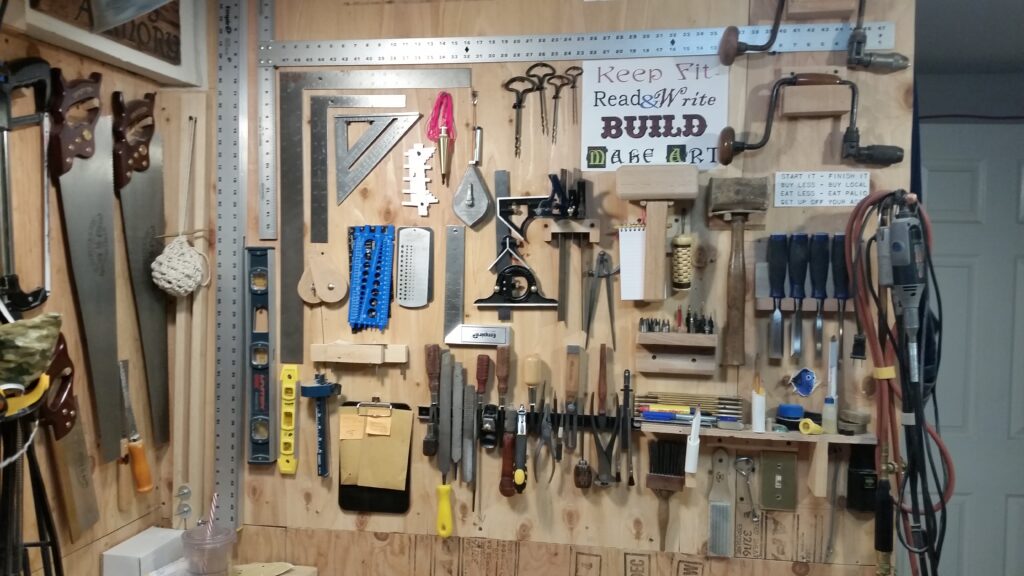
Before moving north from the San Francisco Bay Area to the Klamath Basin, a fair amount of time was spent building a workshop space that focused on bookbinding, restoring old tools, and woodworking.

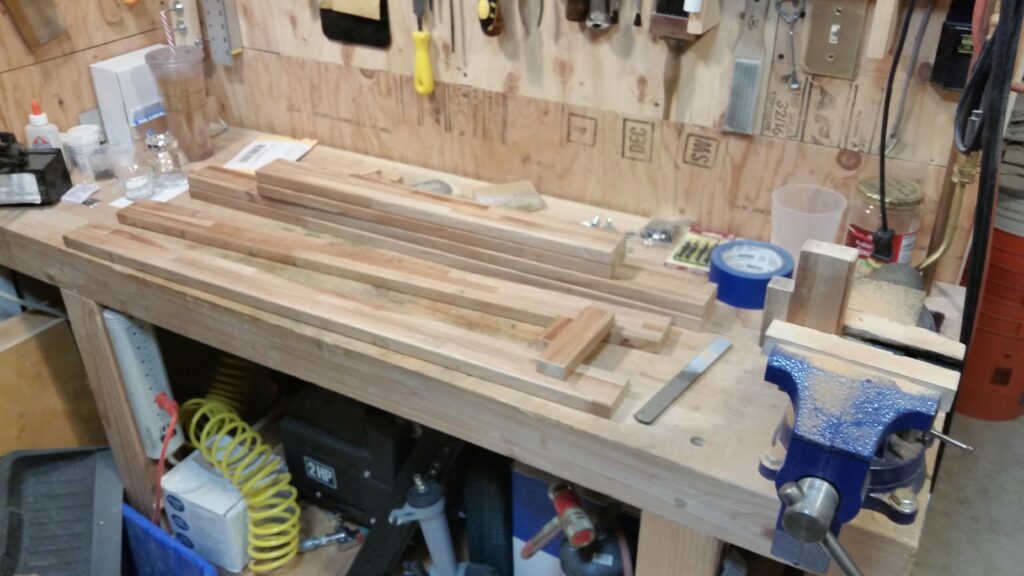
One thing that did not make the move was the workbench. Proper positive workholding is one of the most important keys to effective and safe workshop processes in wood, metal, plastic, or any material. Without a proper workbench since moving, many cherished shop skills have languished in disuse. This week marks a reversal, a new heavy bench is now under construction.

The new bench is an interpretation of the traditional hand tool joiner’s bench. The list of projects that will rely on this bench includes the cabinetry and chests that will replace all of the current shop furniture, making specialized hand tools, making workholding & pressing tools for book repair and binding, and furniture making. Most of these projects will also have a historical component to them, particularly the tool and furniture projects.

One of the concepts under consideration for a dissertation includes developing and employing a framework for Experimental History, using period-appropriate tools and methods to replicate an object of importance to a specific line of research inquiry, whether as an artifact or process. If this concept is to be included in the upcoming dissertation, there will most certainly be a need for tool and pattern making, as well as the construction of the object of inquiry itself. This requires the re-establishment of a working shop, the joiner’s bench being the anchor of the shop.

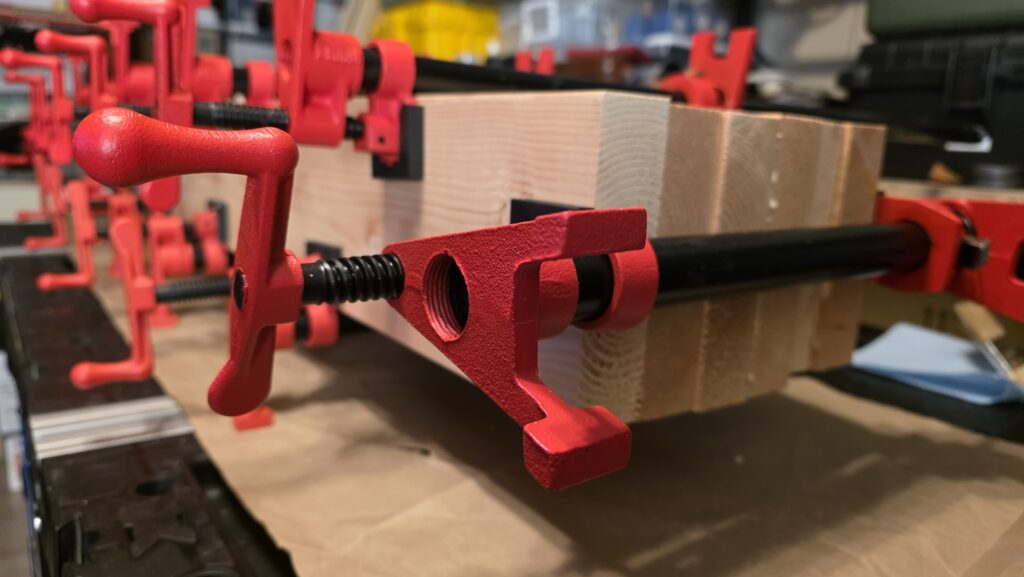
Between shop projects and the possibility of employing Experimental History, the urgency of getting a working hand tool shop up and running is high. To that end, the materials for the bench were acclimating in the shop last week: (10) 2″ x 8″ x 10′ nominal fir construction lumber, and a 6/4 – 14″ x 12′ maple slab. Two days ago, the materials were milled down from nominal lumber to near-dimensional boards, and yesterday, glue-ups started for the major components in rough sizes: (4) legs 5″ x 4″ x 36″, (4) stretchers 5″ x 3″ x 48″, and (1) bench top 5″ x 20″ x 60″. By the end of next week, all of the glue-ups should be done, and final dimensioning can begin. The target size for the bench is a 5″ thick bench top, 20″ deep, 60″ wide, standing 32″ tall, with a 1″ thick fir shelf about 7″ from the floor, inset into the stretchers. The draw-bore mortise and tenon joinery should be all marked out and cut next weekend over the winter solstice. Installation of the mapleface, back, and ends, along with a Moxon-style face vise, tail wagon-vise, the hold-fast and dog holes, and finishing should be done over Christmas week. The plan is to be finished and dressed by January 1st, so work can begin with the new year.

Intentionality II

I applied to Johns Hopkins on July 7th and was accepted on the 17th. My digital presence at the university was processed at a rapid pace, and I had been engrossed in all the preparatory university informational and program-specific reading. I was also focused on completing all of the policy-related training for new students. This occupied the better portion of the week after I was accepted. Then they started to creep into my thoughts, questions.

  • What am I doing?
  • Why am I doing this?
  • Do I need to do this?
  • Does this get me any closer to my goals?
  • How will this affect me in ways I haven’t considered?
  • Why didn’t I consider these questions before now?

This all put me into a contemplative state of mind. I wanted answers to these questions, and more kept coming, so I stopped the new student reading and training and took the afternoon to dig into these questions and assess where this was going. I’ll answer the last question above first because it affects all of the others. I wanted a reputable, secular school on my academic record. It was in many ways a mia culpa for supporting an institution as long as I had. Understanding that motivation and accepting it as truth made it much easier to see the other truths that were to come from this self-reflection.

Truth One. I’m not in my 20s or 30s anymore. That may seem obvious, but honestly, despite the constantly aching knees and restless sleep, I usually feel much younger than I am. I believe that is what has carried me through my academic pursuits of the last seven years.

Truth Two. I don’t want to retire in my 80s. Yikes. At best, I have maybe 20-25 years of useful “work” in me. I would like most of that time to be in a hand tool woodshop or on the water, not worrying about pleasing my 30-year-old boss. Yes, it sounds like a grumpy old guy, and in many ways it is, but it is founded in a lifetime of diverse experience.

Truth Three. I don’t want to be a teacher. It is not that I dislike teaching. On the contrary, I love teaching. I don’t want to teach in the environment created by the current administration. I am also not a fan of the internal politics of the academy. I could see myself teaching part-time as an adjunct, but I would be more fulfilled working on educational programs at a museum. This is where it sunk in that I didn’t want to be a professor.

ETA I have since reconsidered this position to some extent, I do want to teach.

Truth Four. If I am not teaching at the university level, I don’t need a Ph.D. When I started the Ph.D. path, I wanted to teach at the university level. I have to admit, though, that part of the attraction was vanity. To deny that would be untruthful, and this exercise is about truth.

ETA Again, I have reconsidered this position. I do want to teach at the university level; thus, I have reengaged with the doctoral program, taking only one semester off.

Truth Five. I have two master’s degrees. Will a third get me closer to my goals? The short answer is, no, it won’t. In many ways, this answer sucks. I am truly interested in the Cultural Heritage Management program and would rather not withdraw from it. I am so grateful and feel truly blessed that I got into the program. If things were not as they are, I would likely stay in the program just for the edification and enjoyment. Things as they are, I am withdrawing.

Truth Six. My academic career has come to its conclusion. This sounds rather final, almost dark. However, the fact is, I will not be in the academe in a formal sense. I will surely engage with it and may even actively participate in the academe in the future. For now, at least, I am not a student, an instructor, or affiliated with a university. While I am a little sad about that, it is what it is, and I am okay with that.

ETA when I posted this, by academic career, I meant formal academics. However, this too has changed as I return to the doctoral program.

Truth Seven. It’s time to put all of this training to good use. Having taken instruction out of the mix, that leaves public history. There are a lot of directions a historian or public historian can go. Most often, we think of museums and parks, and I had hoped to go in the museum direction. Where we are, geographically, this isn’t a viable direction. Engaging as an independent contractor with governments, businesses, and organizations is the most viable path.

ETA my conciderations here remain. In light of some recent events, I am even more inclined to look for non-local alternatives.

Truth Eight. If I am going to find traditional, institutional employment, it won’t be where we are geographically. There are many parts of the country where a public historian can find work far more easily than in Oregon.

Truth Nine. Doing history and or public history independently is going to require strong self-motivation skills. Like any independent contractor, it’s all on you to make things happen. Fortunately, I have a lot of experience in this.

Truth Ten. Assuming I pursue doing history/public history as an independent contractor, I have a lot of planning and development work to do.

These realizations are split into two tenses, past and present. I needed to see and acknowledge the first six for what they are, so I could process seven on. There is still a lot to do, an understatement to be sure, but it is time to move forward.

ETA I chose to take the fall term off to reflect more on these truths. Very little has changed in the bigger picture. The main change was the decision to return to the doctoral program and finish what I started. My decision is not based on “I’m over half done, I should finish this.” I tuely do want to earn my doctorate in history. While finishing what I started does play a small roll in my decision, it is a very small role. I am committed to this path.

updated December 11, 2025

Intentionality

by Jonathan Wanzer

This site and blog were planned to be strictly professional, with little to no personal material that wasn’t directly related to historical pursuits. This has, however, changed slightly. The blog will instead be a moderated personal reflection, which will enhance the overall site as a portfolio by providing personal context. Efforts will be made to keep the content relevant to the academe, history, genealogy, cultural heritage, and museum studies, and to avoid posts on hobby interests in aviation, maritime, and communications unless they are directly relevant to the former. Discussions in the realm of politics and religion will likewise be moderated to their relevance in the historical and cultural spaces.

One of the key elements of the previous post was the submission of an application to another educational institution. That institution was Johns Hopkins University, and the application was for entry into their M.A. Cultural Heritage Management program in the fall, which was accepted. Classes start August 15th. This promises to be an exciting program with some interesting classes, including Issues in Intangible Cultural Heritage and Culture as Catalyst for Sustainable Development, both of which will be taken in the fall term.

With teaching at the university level off the table for now, the focus will be on expanding skillsets and networking. Time will also be set aside for site work with the local, local history museum. The intention is to develop a broad range of skills centered around museology and cultural heritage. Graduate certificates in fields like cultural anthropology, archaeology, political science, African American studies, Native American studies, and other similar subjects that can be worked on while employed in the field are a good option. JHU has a good Museum Studies program that may be an option after completing the current program. Doing history, public or otherwise, requires a continuous broadening of context. Continuing education and community engagement are the best ways to do this.

Confessions

by Jonathan W. Wanzer
July 16, 2025

The first half of 2025 has been quite the year, hasn’t it?

The division among Americans continues to grow deeper. Factions continue to isolate themselves within their narrow information bubbles, willfully ignorant of what is happening outside their limited perspective. We are all developing mental and emotional stress injuries from just trying to get through the next day. Traumas continue to accumulate, exaggerating emotions, shortening attention spans, and fuses alike, which adds to the division and isolation. Many of us have opted to avoid inevitable conflicts by refusing to talk or write about what we were thinking and feeling out of fear, fear of losing or not getting a job, fear of getting kicked out of school, fear of reprisals, vandalism, or worse, violence. Many of us feared the possibility of isolation from families, rejection from the communities we participate in, and some have feared excommunication from their religious communities for being dissenters and conscientious objectors.

I don’t know about you, but I’m exhausted from all of it.

White supremacists and Christian nationalists, under the cover of MAGA, have generated so much hate and fear across the entire nation and beyond, just to further the avarice and ambitions of dominance of a handful of despicable, hateful people who literally couldn’t care less for the people they have persuaded to support them. Lying to their faces and stealing from them, committing their unethical and illicit actions in plain sight without fear of consequences. Their only concerns are self-aggrandizement and profit. Nothing they do is in the country’s best interest, nor the interests of their constituents. Most certainly, none of their actions are remotely Christian in nature. Their actions, and the fear and hate their actions generate, are indeed the antithesis of Christianity. They exist and thrive on fear and hate, there is no love in their actions or their hearts.

Until now, I have been complicit through my silence.

The school I have been attending contributed significantly to the development of Project 2025, and they continue to contribute to the destruction of the United States Constitution and government through their support of MAGA extremists. My complicity was with a heavy heart, but knowing what I was doing, justifying my complicity with the fear of appearing critical of the institution’s politics, prompting retaliation. Late though it is, my limits have been reached; I can no longer bear the shame of silence and inaction. I have applied to another university and a different program. I am hopeful that at some point in the future, I will be able to continue the path of a terminal degree.

My opinions and beliefs will undoubtedly cause some friction, as will my complicity.

Among my ancestors, several lines came to North America in the seventeenth century. They were immigrants. Whether 300 years ago or 3 days ago, they all made a journey of faith, vision, and hope. Immigrants built, and continue to build, this country. Without immigrants, the country would shrivel and die like an inbred genetic experiment. Likewise, the diverse cultures in America should be celebrated, not restricted, regulated, and whitewashed down to a colorless caricature of an America that never was. I am an ally to all the diverse communities that bring so much to the tapestry of American culture, First Peoples, immigrants, LGBTQIA+, and the displaced and forgotten. I support equality in all aspects of life for all communities. We are all siblings in the human family.

My heart breaks thinking about all those who have been alienated, endangered, and those who will die, because of willful ignorance and hate, in service of greed and authoritarian power.

There is no “us” and “them.” The construct of “the other” is a construct of ignorance, borne of fear, that breeds hate. “The other” is a tool of authoritarianism used to divide and alienate people. To dehumanize segments of the population, making it easier to hate and treat people with cruelty. The enemies of America, and indeed all humanity, are not people, the enemies are ignorance, fear, and hate.

The evils among us can be defeated, ignorance can be defeated, face your fears of “the other,” learn about different cultures, get to know people you don’t agree with, participate in your community, and the communities around you.

In love and hope,
~ Jon

Andrew Jackson Wanzer

Andrew Jackson Wanzer (1873-1889) is my great-great-grandfather. He was born on July 16, 1837, in Kalamazoo, Michigan. He married Malvina Abigail Chase on April 12, 1858, and they began a family. Their first child, Nettie, was premature and died at birth in the winter of 1858. They would go on to have seven more children: George Alvin (1862-1915), Edward Benjamin (1864-1944), Frank Marion (1867-1941), James C. (1869-1928), Olive Jeannette (1872-1872), Hattie B. (1877-1911), and Mortimer Leroy (1878-1947), Mortimer is my great-grandfather. Andrew Jackson Wanzer died on December 29, 1889, in Eau Claire, Wisconsin, where he is buried.

AT REST – A.J. WANZER – July 16, 1837 – Dec. 29 1889 – Co. G. 5. Wis. – Vol.

“Jack” is somewhat enigmatic in that the Wanzer branch ends with him. Malvina, or “Vine,” on the other hand, her line goes back to the early 1700s on her mother’s side (Mason), and her father’s side (Chase) goes back to the mid-1600s in the Massachusetts Bay Colony. The Chase patrilineal line from Malvina goes back seven more generations to Thomas Chase (1592-1627) in Suffolk, England.

The Wanzer line is where I will be focusing my research. The Wanzer name is a derivation of the WANSHAER. Any Wanzer, or other derivation in America before 1920, are descended from Jan Jansen Wanshaer “the first and only person to come to America, by that name, reached New Amsterdam … about 1642…”1 Jan is believed to have been born in 1621 in Cadzand, Holland in the Dutch province of Zeeland.

What we know of “Jack” is mostly from his Union Army service record. He was a lumberman in Black River Falls, Wisconsin, 5′ 7 3/4″, dark eyes, black hair, and a dark complexion. We also have a brief history of his unit the Wisconsin 5th Infantry and Company G2. During his service, he wrote at least four letters to “Vina” that have been kept in the family.

  • Enlisted August 29, 1864, Albion, WI.
  • Mustered In September 13, 1864, Madison WI
    Wisconsin 5th Infantry Company G
  • Between October and November 1864, he made Corporal
  • Letter 1 December 27, 1864, Parks Station, VA
  • Letter 2 March 21, 1865, Warnes Station, VA
    The unit is camped just northwest of Appomattox
  • Lee Surrenders April 6, 1865, Appomattox, VA
  • Letter 3 April 17, 1865, Berk Station, VA
  • Letter 4 April 29, 1865, Danvill, VA
  • Mustered Out June 20, 1865, Hall’s Hill, VA
    What is now High View Park, Arlington, VA

The two letters below in the appendix are from Jack to Vina, dated March 21 and April 17, 1865, respectively.3, 4 They are of interest in part because they frame Lee’s surrender at Appomattox on April 6, 1865. Jack’s unit was camped near Appomattox, and he mentions their being at the surrender after participating in the capture of Petersburg.

Appendix

The letter scans are of both sides of a folded letter so the page layout is the left image, 4 | 1, and the right 2 | 3. The transcriptions below the scans are as the letters were written, with no corrections. The forward slash (/) indicates a new line. Anything between straight brackets ([ ]) was not clear in the scan and presumed correct.

Letter 2 – March 21, 1865

Page 1
March the 21st, 1865 / [?] Warnes Station VA / My dear wife I take my / pen in hand to let you / know that I am well at / this time I have wrot 4 / or five letters to you in / the last 6 or 7 days but I / thought that I would / be on a march be fore this / time but that dont make / much difference I will / right you one to day and / I will send you the / receipt for forty dollars / that I have sent to you / by express I have sent all / of the recipts to you for / the money that I have / sent to you and I have / sent [?] you 2 shirts and / one blanket I sent them / in a box with L T Johnson

Page 2
and we Directed it to / James Davidson I have / wrote to you all a bout / it in my other letters I / dont know how soon we / will have to march from / here our orders is Just the / same that they was when / I wrote my last one to / you it is warm As / summer here the grass is / green here and every thing / is pleasent I think that / this cruel war Cannot / last much longer for / our army is getting the / Johneys is getting in clost / quartersand thay ar getting / beat in every fight that / is faught Shearman and / Sheridan is playing them / the duce and our army

Page 3
is holding the Johneys / tight so they have to stay / here so that thay Cannot / reinforse one another so I / think that the Johneys / will have to surrender / be fore 2 months from / this time I dont see any / chance for the Johneys at / all I must close for this / time I would Just say that / our Captin has left and we / dont cry a bout it I think / that oald Squires will / be discharged from this / company be fore long he is / under a coart martial / this day all of our company / is well and looks fine / I will close for this time / right often and dont forget / this from your Jack Wanzer / to vine

Letter 3 – April 17, 1865

Page 1
Berks Station / April the 17th 1865 VA / My dear wife I take this time to / let you know that I am well / and have got to my company / all right I found them / encamped in the pine woods / and we ar a bout 52 miles / from peters burgh our regiment / was at the surrender of general / lees army and after the surrender / they marched to where we ar / and we dont know how long / we will stay here but one / thing is sure that this war / is a bout to a close all of / the boyes is in good health / and feels fine we think that / we will be at home by the / 4th of July and I dont see / any thing in the way at / this time the weather is / warm here and pleasent

Page 2
Our regiment has been in / thre fights since I was at / home our regiment has lost / 2 hundred men our company/ lost 26 men in killed and / wounded James Conlin was / killed dead on the field / and Samuel Virnow was / wounded bad and the boyes / thinks that he is dead but / we dont know surtin all of / the boys went in to the fight / that was from our town but / Noah A Decker and he runn / a way and we dont know ware / he is he is one coward from / Blackriver falls Oald quires was / shot in the stearn and he / has 5 holes tht will tell which / way he was going I have knot / got much news to right / at this time but we think

Page 3
that our boyes will go to / Washington in a short time / our boyes is got the praise of / the capture of peters burgh / and our regiment was the / first in to the Johneys / fort our boys from wisconsin / is Just the boyes that can / Climb the brest work our / regiment had a hard a hard fight / with general Euiels men at / litle salor creek and thay / helped to capture 10,000 prisoner / Samul kinnion and cooper / got back to ther regimen / all right I must close / for this time Our boyes has / been excused from all / field duty for our bravery / I will put this confedeate / bill in this letter to let / you see it right as soon as

Page 4
get this I hope you / ar well good By / This from your / A J Wanzer / To his wife Vine wanzer / I got a letter from my / sister Ann since I / got Back here / you can write to ann / and tell her what I want / Just as well as I can

  1. William David Wanzer, History of the Wanzer Family in America, from the Settelment in New Amsterdam, New York, 1642-1920, Medford, MA: Medford Mercury Press, 1920. ↩︎
  2. E.B. Quiner, The Military History of Wisconsin: A Record of the Civil and Military Patriotism of the State, in the War for the Union, With a History of the Campaigns in Which Wisconsin Soldiers Have Been Conspicuous – Regimental Histories – Sketches of Distinguished Officers – The Role of the Illustrious Dead – Movements of the Legislature and State Officers, Etc., Chicago, IL: Clarke & Company, 1866. ↩︎
  3. Andrew Jackson Wanzer to Malvina Abigail Chase Wanzer, March 21, 1865, Jonathan Wanzer Family Genealogy Collection, Klamath Falls, OR.) ↩︎
  4. Andrew Jackson Wanzer to Malvina Abigail Chase Wanzer, April 17, 1865, Jonathan Wanzer Family Genealogy Collection, Klamath Falls, OR. ↩︎

Slavery in America: A sampling


By: Jonathan Wanzer ORCiD 0009-0004-9275-7410
Submitted on: April 5, 2025
Submitted to: Dr. Schultz – Liberty University
Course: HIST 701 Historical Professions
Chicago Citation:
Wanzer, Jonathan. “Slavery in America: A Sampling.” Historical Interpretations (blog). April 5, 2025. http://wanzer.org/2025/04/slavery-in-america-a-sampling/.

Abstract
This blog post takes a look at slavery from the narrow perspective of the New Hampshire Methodist Episcopal Church through its conference minutes of 1844-1845. It looks at the church’s Committee on Slavery’s position paper and resolutions in its report to the conference. The committee states its abolitionist views clearly and in strong, unequivocal terms. It also addresses the north-south schism forming within the church. The post’s conclusion places the conference minutes in context with the Civil War, and in its analysis, it asserts that the underpinning concepts of slavery are with us to this day.


Preface

The topic of slavery in America is a topic charged with emotions, regardless of the perspective from which you view it. As an older guy, a descendant of Northern and Western European ancestry, I find this a complex topic to approach. However, it is a topic I have been paying more attention to in recent years. In a class on the Civil War a book by Charles B. Dew came to my attention, Apostles of Disunion.1 Dew’s book fanned the flames of inquiry urging me to look below the surface when researching subjects that have racial or ethnic discriminatory elements, be it aboriginal peoples, the enslaved, or any other opposing people groups. This post, aside from being a class assignment,2 addresses an important topic that should be better understood by every American, slavery in the American context. This post is only one narrow look at a complex topic.

Methodist Episcopal Church,
New Hampshire Conference 1844-45

The Minutes of the New Hampshire Annual Conference of the Methodist Episcopal Church for the year of 1844-45 provides a lot of information about the church at this time in a short 22 pages. It addresses topics from membership to finances, appointments, and obituaries. It also contains two position papers with resolutions on topics that would become very important to the country in the coming decades. The minutes contain position papers on Temperance and Slavery.

Division over the topic of slavery has been a part of political discourse in America since the debate over independence in the Second Continental Congress. Despite participation in the slave trade and many of the founding fathers owning slaves themselves, the north-south division on the subject has manifested in many ways ever since. One has been through the publishing of position papers, often by civic groups including those specifically focused on abolition, and in position papers and resolutions published by organizations in their charters and minutes from various organization-wide meetings, conventions, congresses, and conferences.

The Methodist Episcopal Church had, according to its 1844-45 Conference minutes, a Committee on Slavery that had “for several successive years past presented” their sentiments on slavery as “the great evil and sin of American Slavery.” Having restated their position several times already, but recognizing the importance of the matter they felt “duty bound” to again address slavery and make sure the church and world knew that “the slave in his bonds and deprivations has not lost our sympathy.”3 Following this with a commitment to abolishing the practice.

New Hampshire Methodists were not alone in this sentiment finding slavery a moral evil, offensive to God, and ruinous “to the best interests of the church and nation.” They further pronounced that the destiny of slavery was fixed, that the practice must die. Acknowledging that a schism was forming within the larger church, they were sure that Providence was on their side. The committee also predicted that a change was coming, that they would be “free from all connection” with the practice of slavery. To further state their position and to address the succession of southern churches they concluded the committee report with nine resolutions summarized here:

The committee resolved that the practice of slavery was a great evil. Traveling lecturers should denounce the practice of defending slavery through the pretext that it benefitted the slave. Through the secession of dissenting churches, they would be “ecclesiastically free from connection with this great evil.” If southern churches chose slavery over their alienation from the greater church, they should be pitied rather than deplored. Those in dissenting churches not holding slaves should join the northern churches in “spreading scriptural holiness.” The resolutions also included thanks to leadership supporting abolition and rebuking those dissenting and in favor of secession.

Conclusion

This division in the Methodist church over slavery took place a full fifteen years before the Secession Commissioners 4 took to the meetinghouses of the south and west to sow the seeds of secession in America. Slavery has been a part of American history since its inception. While the buying and selling of people is no longer legal, the underpinning concepts that allowed slavery to flourish are still with us. The concepts of us v. them and fear of the other, the dehumanization of the other, to refer to them as inferior, to justify abhorrent actions and inhumane treatment. This is evil.


  1. Charles B. Dew, Apostles of Disunion: Southern Secession Commissioners and the Causes of the Civil War, Charlottesville, VA: University of Virginia Press, 2016. ↩︎
  2. Liberty University, HIST 701 Historical Professions: Module 3: Blog: American Christianity. ↩︎
  3. Methodist Episcopal Church, New Hampshire Conference, Minutes of the New Hampshire Annual Conference of the Methodist Episcopal Church, Vol. 1844-45, Boston, MA: D.H. Ela, 1845. Sabin Americana: History of the Americas, 1500-1926. Accessed April 5, 2025. 11-13. https://link.gale.com/apps/doc/CY0109925437/SABN?u=vic_liberty&sid=bookmark-SABN&xid=8aaaa08f&pg=1. ↩︎
  4. Dew, 2016. ↩︎