Intentionality II

I applied to Johns Hopkins on July 7th and was accepted on the 17th. My digital presence at the university was processed at a rapid pace, and I had been engrossed in all the preparatory university informational and program-specific reading. I was also focused on completing all of the policy-related training for new students. This occupied the better portion of the week after I was accepted. Then they started to creep into my thoughts, questions.

  • What am I doing?
  • Why am I doing this?
  • Do I need to do this?
  • Does this get me any closer to my goals?
  • How will this affect me in ways I haven’t considered?
  • Why didn’t I consider these questions before now?

This all put me into a contemplative state of mind. I wanted answers to these questions, and more kept coming, so I stopped the new student reading and training and took the afternoon to dig into these questions and assess where this was going. I’ll answer the last question above first because it affects all of the others. I wanted a reputable, secular school on my academic record. It was in many ways a mia culpa for supporting an institution as long as I had. Understanding that motivation and accepting it as truth made it much easier to see the other truths that were to come from this self-reflection.

Truth One. I’m not in my 20s or 30s anymore. That may seem obvious, but honestly, despite the constantly aching knees and restless sleep, I usually feel much younger than I am. I believe that is what has carried me through my academic pursuits of the last seven years.

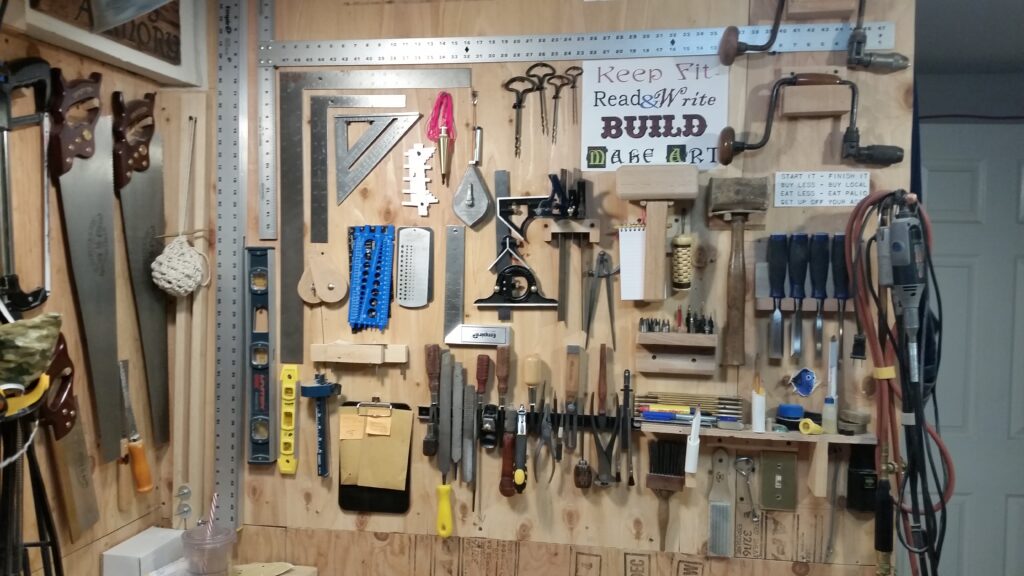
Truth Two. I don’t want to retire in my 80s. Yikes. At best, I have maybe 20-25 years of useful “work” in me. I would like most of that time to be in a hand tool woodshop or on the water, not worrying about pleasing my 30-year-old boss. Yes, it sounds like a grumpy old guy, and in many ways it is, but it is founded in a lifetime of diverse experience.

Truth Three. I don’t want to be a teacher. It is not that I dislike teaching. On the contrary, I love teaching. I don’t want to teach in the environment created by the current administration. I am also not a fan of the internal politics of the academy. I could see myself teaching part-time as an adjunct, but I would be more fulfilled working on educational programs at a museum. This is where it sunk in that I didn’t want to be a professor.

ETA I have since reconsidered this position to some extent, I do want to teach.

Truth Four. If I am not teaching at the university level, I don’t need a Ph.D. When I started the Ph.D. path, I wanted to teach at the university level. I have to admit, though, that part of the attraction was vanity. To deny that would be untruthful, and this exercise is about truth.

ETA Again, I have reconsidered this position. I do want to teach at the university level; thus, I have reengaged with the doctoral program, taking only one semester off.

Truth Five. I have two master’s degrees. Will a third get me closer to my goals? The short answer is, no, it won’t. In many ways, this answer sucks. I am truly interested in the Cultural Heritage Management program and would rather not withdraw from it. I am so grateful and feel truly blessed that I got into the program. If things were not as they are, I would likely stay in the program just for the edification and enjoyment. Things as they are, I am withdrawing.

Truth Six. My academic career has come to its conclusion. This sounds rather final, almost dark. However, the fact is, I will not be in the academe in a formal sense. I will surely engage with it and may even actively participate in the academe in the future. For now, at least, I am not a student, an instructor, or affiliated with a university. While I am a little sad about that, it is what it is, and I am okay with that.

ETA when I posted this, by academic career, I meant formal academics. However, this too has changed as I return to the doctoral program.

Truth Seven. It’s time to put all of this training to good use. Having taken instruction out of the mix, that leaves public history. There are a lot of directions a historian or public historian can go. Most often, we think of museums and parks, and I had hoped to go in the museum direction. Where we are, geographically, this isn’t a viable direction. Engaging as an independent contractor with governments, businesses, and organizations is the most viable path.

ETA my conciderations here remain. In light of some recent events, I am even more inclined to look for non-local alternatives.

Truth Eight. If I am going to find traditional, institutional employment, it won’t be where we are geographically. There are many parts of the country where a public historian can find work far more easily than in Oregon.

Truth Nine. Doing history and or public history independently is going to require strong self-motivation skills. Like any independent contractor, it’s all on you to make things happen. Fortunately, I have a lot of experience in this.

Truth Ten. Assuming I pursue doing history/public history as an independent contractor, I have a lot of planning and development work to do.

These realizations are split into two tenses, past and present. I needed to see and acknowledge the first six for what they are, so I could process seven on. There is still a lot to do, an understatement to be sure, but it is time to move forward.

ETA I chose to take the fall term off to reflect more on these truths. Very little has changed in the bigger picture. The main change was the decision to return to the doctoral program and finish what I started. My decision is not based on “I’m over half done, I should finish this.” I tuely do want to earn my doctorate in history. While finishing what I started does play a small roll in my decision, it is a very small role. I am committed to this path.

updated December 11, 2025

Intentionality

by Jonathan Wanzer

This site and blog were planned to be strictly professional, with little to no personal material that wasn’t directly related to historical pursuits. This has, however, changed slightly. The blog will instead be a moderated personal reflection, which will enhance the overall site as a portfolio by providing personal context. Efforts will be made to keep the content relevant to the academe, history, genealogy, cultural heritage, and museum studies, and to avoid posts on hobby interests in aviation, maritime, and communications unless they are directly relevant to the former. Discussions in the realm of politics and religion will likewise be moderated to their relevance in the historical and cultural spaces.

One of the key elements of the previous post was the submission of an application to another educational institution. That institution was Johns Hopkins University, and the application was for entry into their M.A. Cultural Heritage Management program in the fall, which was accepted. Classes start August 15th. This promises to be an exciting program with some interesting classes, including Issues in Intangible Cultural Heritage and Culture as Catalyst for Sustainable Development, both of which will be taken in the fall term.

With teaching at the university level off the table for now, the focus will be on expanding skillsets and networking. Time will also be set aside for site work with the local, local history museum. The intention is to develop a broad range of skills centered around museology and cultural heritage. Graduate certificates in fields like cultural anthropology, archaeology, political science, African American studies, Native American studies, and other similar subjects that can be worked on while employed in the field are a good option. JHU has a good Museum Studies program that may be an option after completing the current program. Doing history, public or otherwise, requires a continuous broadening of context. Continuing education and community engagement are the best ways to do this.

Confessions

by Jonathan W. Wanzer
July 16, 2025

The first half of 2025 has been quite the year, hasn’t it?

The division among Americans continues to grow deeper. Factions continue to isolate themselves within their narrow information bubbles, willfully ignorant of what is happening outside their limited perspective. We are all developing mental and emotional stress injuries from just trying to get through the next day. Traumas continue to accumulate, exaggerating emotions, shortening attention spans, and fuses alike, which adds to the division and isolation. Many of us have opted to avoid inevitable conflicts by refusing to talk or write about what we were thinking and feeling out of fear, fear of losing or not getting a job, fear of getting kicked out of school, fear of reprisals, vandalism, or worse, violence. Many of us feared the possibility of isolation from families, rejection from the communities we participate in, and some have feared excommunication from their religious communities for being dissenters and conscientious objectors.

I don’t know about you, but I’m exhausted from all of it.

White supremacists and Christian nationalists, under the cover of MAGA, have generated so much hate and fear across the entire nation and beyond, just to further the avarice and ambitions of dominance of a handful of despicable, hateful people who literally couldn’t care less for the people they have persuaded to support them. Lying to their faces and stealing from them, committing their unethical and illicit actions in plain sight without fear of consequences. Their only concerns are self-aggrandizement and profit. Nothing they do is in the country’s best interest, nor the interests of their constituents. Most certainly, none of their actions are remotely Christian in nature. Their actions, and the fear and hate their actions generate, are indeed the antithesis of Christianity. They exist and thrive on fear and hate, there is no love in their actions or their hearts.

Until now, I have been complicit through my silence.

The school I have been attending contributed significantly to the development of Project 2025, and they continue to contribute to the destruction of the United States Constitution and government through their support of MAGA extremists. My complicity was with a heavy heart, but knowing what I was doing, justifying my complicity with the fear of appearing critical of the institution’s politics, prompting retaliation. Late though it is, my limits have been reached; I can no longer bear the shame of silence and inaction. I have applied to another university and a different program. I am hopeful that at some point in the future, I will be able to continue the path of a terminal degree.

My opinions and beliefs will undoubtedly cause some friction, as will my complicity.

Among my ancestors, several lines came to North America in the seventeenth century. They were immigrants. Whether 300 years ago or 3 days ago, they all made a journey of faith, vision, and hope. Immigrants built, and continue to build, this country. Without immigrants, the country would shrivel and die like an inbred genetic experiment. Likewise, the diverse cultures in America should be celebrated, not restricted, regulated, and whitewashed down to a colorless caricature of an America that never was. I am an ally to all the diverse communities that bring so much to the tapestry of American culture, First Peoples, immigrants, LGBTQIA+, and the displaced and forgotten. I support equality in all aspects of life for all communities. We are all siblings in the human family.

My heart breaks thinking about all those who have been alienated, endangered, and those who will die, because of willful ignorance and hate, in service of greed and authoritarian power.

There is no “us” and “them.” The construct of “the other” is a construct of ignorance, borne of fear, that breeds hate. “The other” is a tool of authoritarianism used to divide and alienate people. To dehumanize segments of the population, making it easier to hate and treat people with cruelty. The enemies of America, and indeed all humanity, are not people, the enemies are ignorance, fear, and hate.

The evils among us can be defeated, ignorance can be defeated, face your fears of “the other,” learn about different cultures, get to know people you don’t agree with, participate in your community, and the communities around you.

In love and hope,
~ Jon

Andrew Jackson Wanzer

Andrew Jackson Wanzer (1873-1889) is my great-great-grandfather. He was born on July 16, 1837, in Kalamazoo, Michigan. He married Malvina Abigail Chase on April 12, 1858, and they began a family. Their first child, Nettie, was premature and died at birth in the winter of 1858. They would go on to have seven more children: George Alvin (1862-1915), Edward Benjamin (1864-1944), Frank Marion (1867-1941), James C. (1869-1928), Olive Jeannette (1872-1872), Hattie B. (1877-1911), and Mortimer Leroy (1878-1947), Mortimer is my great-grandfather. Andrew Jackson Wanzer died on December 29, 1889, in Eau Claire, Wisconsin, where he is buried.

AT REST – A.J. WANZER – July 16, 1837 – Dec. 29 1889 – Co. G. 5. Wis. – Vol.

“Jack” is somewhat enigmatic in that the Wanzer branch ends with him. Malvina, or “Vine,” on the other hand, her line goes back to the early 1700s on her mother’s side (Mason), and her father’s side (Chase) goes back to the mid-1600s in the Massachusetts Bay Colony. The Chase patrilineal line from Malvina goes back seven more generations to Thomas Chase (1592-1627) in Suffolk, England.

The Wanzer line is where I will be focusing my research. The Wanzer name is a derivation of the WANSHAER. Any Wanzer, or other derivation in America before 1920, are descended from Jan Jansen Wanshaer “the first and only person to come to America, by that name, reached New Amsterdam … about 1642…”1 Jan is believed to have been born in 1621 in Cadzand, Holland in the Dutch province of Zeeland.

What we know of “Jack” is mostly from his Union Army service record. He was a lumberman in Black River Falls, Wisconsin, 5′ 7 3/4″, dark eyes, black hair, and a dark complexion. We also have a brief history of his unit the Wisconsin 5th Infantry and Company G2. During his service, he wrote at least four letters to “Vina” that have been kept in the family.

  • Enlisted August 29, 1864, Albion, WI.
  • Mustered In September 13, 1864, Madison WI
    Wisconsin 5th Infantry Company G
  • Between October and November 1864, he made Corporal
  • Letter 1 December 27, 1864, Parks Station, VA
  • Letter 2 March 21, 1865, Warnes Station, VA
    The unit is camped just northwest of Appomattox
  • Lee Surrenders April 6, 1865, Appomattox, VA
  • Letter 3 April 17, 1865, Berk Station, VA
  • Letter 4 April 29, 1865, Danvill, VA
  • Mustered Out June 20, 1865, Hall’s Hill, VA
    What is now High View Park, Arlington, VA

The two letters below in the appendix are from Jack to Vina, dated March 21 and April 17, 1865, respectively.3, 4 They are of interest in part because they frame Lee’s surrender at Appomattox on April 6, 1865. Jack’s unit was camped near Appomattox, and he mentions their being at the surrender after participating in the capture of Petersburg.

Appendix

The letter scans are of both sides of a folded letter so the page layout is the left image, 4 | 1, and the right 2 | 3. The transcriptions below the scans are as the letters were written, with no corrections. The forward slash (/) indicates a new line. Anything between straight brackets ([ ]) was not clear in the scan and presumed correct.

Letter 2 – March 21, 1865

Page 1
March the 21st, 1865 / [?] Warnes Station VA / My dear wife I take my / pen in hand to let you / know that I am well at / this time I have wrot 4 / or five letters to you in / the last 6 or 7 days but I / thought that I would / be on a march be fore this / time but that dont make / much difference I will / right you one to day and / I will send you the / receipt for forty dollars / that I have sent to you / by express I have sent all / of the recipts to you for / the money that I have / sent to you and I have / sent [?] you 2 shirts and / one blanket I sent them / in a box with L T Johnson

Page 2
and we Directed it to / James Davidson I have / wrote to you all a bout / it in my other letters I / dont know how soon we / will have to march from / here our orders is Just the / same that they was when / I wrote my last one to / you it is warm As / summer here the grass is / green here and every thing / is pleasent I think that / this cruel war Cannot / last much longer for / our army is getting the / Johneys is getting in clost / quartersand thay ar getting / beat in every fight that / is faught Shearman and / Sheridan is playing them / the duce and our army

Page 3
is holding the Johneys / tight so they have to stay / here so that thay Cannot / reinforse one another so I / think that the Johneys / will have to surrender / be fore 2 months from / this time I dont see any / chance for the Johneys at / all I must close for this / time I would Just say that / our Captin has left and we / dont cry a bout it I think / that oald Squires will / be discharged from this / company be fore long he is / under a coart martial / this day all of our company / is well and looks fine / I will close for this time / right often and dont forget / this from your Jack Wanzer / to vine

Letter 3 – April 17, 1865

Page 1
Berks Station / April the 17th 1865 VA / My dear wife I take this time to / let you know that I am well / and have got to my company / all right I found them / encamped in the pine woods / and we ar a bout 52 miles / from peters burgh our regiment / was at the surrender of general / lees army and after the surrender / they marched to where we ar / and we dont know how long / we will stay here but one / thing is sure that this war / is a bout to a close all of / the boyes is in good health / and feels fine we think that / we will be at home by the / 4th of July and I dont see / any thing in the way at / this time the weather is / warm here and pleasent

Page 2
Our regiment has been in / thre fights since I was at / home our regiment has lost / 2 hundred men our company/ lost 26 men in killed and / wounded James Conlin was / killed dead on the field / and Samuel Virnow was / wounded bad and the boyes / thinks that he is dead but / we dont know surtin all of / the boys went in to the fight / that was from our town but / Noah A Decker and he runn / a way and we dont know ware / he is he is one coward from / Blackriver falls Oald quires was / shot in the stearn and he / has 5 holes tht will tell which / way he was going I have knot / got much news to right / at this time but we think

Page 3
that our boyes will go to / Washington in a short time / our boyes is got the praise of / the capture of peters burgh / and our regiment was the / first in to the Johneys / fort our boys from wisconsin / is Just the boyes that can / Climb the brest work our / regiment had a hard a hard fight / with general Euiels men at / litle salor creek and thay / helped to capture 10,000 prisoner / Samul kinnion and cooper / got back to ther regimen / all right I must close / for this time Our boyes has / been excused from all / field duty for our bravery / I will put this confedeate / bill in this letter to let / you see it right as soon as

Page 4
get this I hope you / ar well good By / This from your / A J Wanzer / To his wife Vine wanzer / I got a letter from my / sister Ann since I / got Back here / you can write to ann / and tell her what I want / Just as well as I can

  1. William David Wanzer, History of the Wanzer Family in America, from the Settelment in New Amsterdam, New York, 1642-1920, Medford, MA: Medford Mercury Press, 1920. ↩︎
  2. E.B. Quiner, The Military History of Wisconsin: A Record of the Civil and Military Patriotism of the State, in the War for the Union, With a History of the Campaigns in Which Wisconsin Soldiers Have Been Conspicuous – Regimental Histories – Sketches of Distinguished Officers – The Role of the Illustrious Dead – Movements of the Legislature and State Officers, Etc., Chicago, IL: Clarke & Company, 1866. ↩︎
  3. Andrew Jackson Wanzer to Malvina Abigail Chase Wanzer, March 21, 1865, Jonathan Wanzer Family Genealogy Collection, Klamath Falls, OR.) ↩︎
  4. Andrew Jackson Wanzer to Malvina Abigail Chase Wanzer, April 17, 1865, Jonathan Wanzer Family Genealogy Collection, Klamath Falls, OR. ↩︎

Slavery in America: A sampling


By: Jonathan Wanzer ORCiD 0009-0004-9275-7410
Submitted on: April 5, 2025
Submitted to: Dr. Schultz – Liberty University
Course: HIST 701 Historical Professions
Chicago Citation:
Wanzer, Jonathan. “Slavery in America: A Sampling.” Historical Interpretations. Jonathan Wanzer, April 5, 2025. http://wanzer.org/2025/04/slavery-in-america-a-sampling/.

Abstract
This blog post takes a look at slavery from the narrow perspective of the New Hampshire Methodist Episcopal Church through its conference minutes of 1844-1845. It looks at the church’s Committee on Slavery’s position paper and resolutions in its report to the conference. The committee states its abolitionist views clearly and in strong, unequivocal terms. It also addresses the north-south schism forming within the church. The post’s conclusion places the conference minutes in context with the Civil War, and in its analysis, it asserts that the underpinning concepts of slavery are with us to this day.


Preface

The topic of slavery in America is a topic charged with emotions, regardless of the perspective from which you view it. As an older guy, a descendant of Northern and Western European ancestry, I find this a complex topic to approach. However, it is a topic I have been paying more attention to in recent years. In a class on the Civil War a book by Charles B. Dew came to my attention, Apostles of Disunion.1 Dew’s book fanned the flames of inquiry urging me to look below the surface when researching subjects that have racial or ethnic discriminatory elements, be it aboriginal peoples, the enslaved, or any other opposing people groups. This post, aside from being a class assignment,2 addresses an important topic that should be better understood by every American, slavery in the American context. This post is only one narrow look at a complex topic.

Methodist Episcopal Church,
New Hampshire Conference 1844-45

The Minutes of the New Hampshire Annual Conference of the Methodist Episcopal Church for the year of 1844-45 provides a lot of information about the church at this time in a short 22 pages. It addresses topics from membership to finances, appointments, and obituaries. It also contains two position papers with resolutions on topics that would become very important to the country in the coming decades. The minutes contain position papers on Temperance and Slavery.

Division over the topic of slavery has been a part of political discourse in America since the debate over independence in the Second Continental Congress. Despite participation in the slave trade and many of the founding fathers owning slaves themselves, the north-south division on the subject has manifested in many ways ever since. One has been through the publishing of position papers, often by civic groups including those specifically focused on abolition, and in position papers and resolutions published by organizations in their charters and minutes from various organization-wide meetings, conventions, congresses, and conferences.

The Methodist Episcopal Church had, according to its 1844-45 Conference minutes, a Committee on Slavery that had “for several successive years past presented” their sentiments on slavery as “the great evil and sin of American Slavery.” Having restated their position several times already, but recognizing the importance of the matter they felt “duty bound” to again address slavery and make sure the church and world knew that “the slave in his bonds and deprivations has not lost our sympathy.”3 Following this with a commitment to abolishing the practice.

New Hampshire Methodists were not alone in this sentiment finding slavery a moral evil, offensive to God, and ruinous “to the best interests of the church and nation.” They further pronounced that the destiny of slavery was fixed, that the practice must die. Acknowledging that a schism was forming within the larger church, they were sure that Providence was on their side. The committee also predicted that a change was coming, that they would be “free from all connection” with the practice of slavery. To further state their position and to address the succession of southern churches they concluded the committee report with nine resolutions summarized here:

The committee resolved that the practice of slavery was a great evil. Traveling lecturers should denounce the practice of defending slavery through the pretext that it benefitted the slave. Through the secession of dissenting churches, they would be “ecclesiastically free from connection with this great evil.” If southern churches chose slavery over their alienation from the greater church, they should be pitied rather than deplored. Those in dissenting churches not holding slaves should join the northern churches in “spreading scriptural holiness.” The resolutions also included thanks to leadership supporting abolition and rebuking those dissenting and in favor of secession.

Conclusion

This division in the Methodist church over slavery took place a full fifteen years before the Secession Commissioners 4 took to the meetinghouses of the south and west to sow the seeds of secession in America. Slavery has been a part of American history since its inception. While the buying and selling of people is no longer legal, the underpinning concepts that allowed slavery to flourish are still with us. The concepts of us v. them and fear of the other, the dehumanization of the other, to refer to them as inferior, to justify abhorrent actions and inhumane treatment. This is evil.


  1. Charles B. Dew, Apostles of Disunion: Southern Secession Commissioners and the Causes of the Civil War, Charlottesville, VA: University of Virginia Press, 2016. ↩︎
  2. Liberty University, HIST 701 Historical Professions: Module 3: Blog: American Christianity. ↩︎
  3. Methodist Episcopal Church, New Hampshire Conference, Minutes of the New Hampshire Annual Conference of the Methodist Episcopal Church, Vol. 1844-45, Boston, MA: D.H. Ela, 1845. Sabin Americana: History of the Americas, 1500-1926. Accessed April 5, 2025. 11-13. https://link.gale.com/apps/doc/CY0109925437/SABN?u=vic_liberty&sid=bookmark-SABN&xid=8aaaa08f&pg=1. ↩︎
  4. Dew, 2016. ↩︎

Experimental History

My current research is a historiographical pursuit to determine if Experimental History exists as a subfield of history. If it does exist, the research will seek out its methodologies and practices. If it does not already exist as a sub-field of history, the research will be to define working parameters and define appropriate methodologies. This will include acknowledging the similarities and differences between Experimental History and Experimental Archaeology.

I discovered this week that the term Experimental History has often applied to a philosophy applied to the study of Natural History in the 17th and 18th centuries by Francis Bacon who dubbed the philosophy “Natural and Experimental History.”1 Bacon’s use of this term has nothing to do with the practice and study of doing history as we think of it today. Searching for academic journal articles on JSTOR,2 the vast majority of search results for “Experimental History” refer to or relate to Bacon’s “Natural and Experimental History.”

A couple of relevant results did come up, one is an article in the journal The History Teacher, “A Pedagogical Trebuchet: A Case Study in Experimental History and History Pedagogy”3 from 2012 that utilizes Experimental History in the classroom to answer questions that would otherwise be unanswerable other than through hypothetical assertions.

My interpretation of Experimental History as a sub-field can, on the research end, help in producing improved tools and materials for Experiential Learning. Anyone who has worked with elementary school kids will likely have plenty of anecdotal experience with the potential of experiential learning. I came to my interpretation of what Experimental history could be through Experimental Archaeology, and one of the reasons I became interested in Experimental Archaeology was my own experience in experiential learning. This is how I learn best, through doing, and following that up with teaching someone else. The process of learning through experimentation and then turning around and teaching what you have learned through papers and presentations is the cornerstone and heart of Amateur Radio. The process works.

The idea behind Experimental History, in my interpretation, is for the researcher to engage in experiential learning, using experimentation along with traditional research to answer questions about the subject, and to apply the physicality of the experimentation and research contextually and physically to generate the resulting products of their research, which should include materials for pedagogical use. I am inclined toward producing products that can be applied in the public history sphere but are not limited to that environment. While the physicality of Experimental History can provide context to traditional outputs, that physicality shouldn’t be lost in the translation, Experimental History, as I interpret it, wants to bring the physicality to all interpretive environments, in the presentation, in the museum, and in the classroom.

This historiographical look at Experimental History and its applications in research and pedagogy is the foundation of my current work and is in its initial stage to understand what the literature is, if any, and to enumerate and evaluate the available sources if such sources exist. As literature emerges I will post it to a designated area of the site.

  1. Anstey, Peter R. “Locke, Bacon and Natural History.” Early Science and Medicine 7, no. 1 (2002): 65–92. http://www.jstor.org/stable/4130409. ↩︎
  2. https://www.jstor.org/ ↩︎
  3. Brice, Lee L., and Steven Catania. “A Pedagogical Trebuchet: A Case Study in Experimental History and History Pedagogy.” The History Teacher 46, no. 1 (2012): 67–84. http://www.jstor.org/stable/43264074. ↩︎

Benchmarking

I am just starting the second week of HIST 701 Historical Professions, and I am already finding the class interesting and challenging. One of this week’s assignments is a benchmarking assignment. I opted to look at graduate history programs here in Oregon, offered by institutions that report having graduate programs in history. Below is the paper submitted.


By: Jonathan Wanzer ORCiD 0009-0004-9275-7410
Submitted on: March 23, 2025
Submitted to: Dr. Schultz – Liberty University
Course: HIST 701 Historical Professions
Chicago Citation:
Wanzer, Jonathan. “Benchmarking Programs: History Programs at Universities in Oregon That Offer Graduate Degrees.” Paper. Historical Interpretations. Jonathan Wanzer, December 2, 2024. http://wanzer.org/2025/03/benchmarking/.


Benchmarking Programs: History Programs at Universities in Oregon That Offer Graduate Degrees

by Jonathan Wanzer
March 23, 2025
ORCID.org/0009-0004-9275-7410

This analysis focuses on degrees offered by colleges and universities with graduate programs in history in Oregon, the number of history degrees awarded in the 2022-2023 program year, and the percentage history degrees represent in the institution’s total degrees awarded. Data was collected from the National Center for Education Statistics, College Navigator website using the search parameters: Oregon, advanced degrees with the following Programs/Majors selected American History, General History, Public/Applied History.[1] The search results indicate that four Oregon universities offer advanced degrees in history. The Institutions indicated are; Oregon State University[2], Portland State University[3], University of Oregon[4], and Western Oregon University[5].

Oregon State University offers bachelor’s and master’s degree programs in history. In the program year, OSU awarded a total of 7,389 degrees, 5,829 bachelor’s, 1,140 master’s, and 420 doctorates. Of these, OSU awarded 59 bachelor’s and 4 master’s degrees in history, slightly over 1% and 0.35% respectively. A doctoral program in history is not available at OSU.

Portland State University offers bachelor’s and master’s degree programs in history. In the program year, PSU awarded a total of 5,621 degrees, 3,839 bachelor’s, 1,717 master’s, and 65 doctorates. Of these, PSU awarded 46 bachelor’s, and 4 master’s degrees in history, just under 1.2% and 0.23% respectively. A doctoral program is not available in history at PSU.

University of Oregon offers bachelor’s, master’s, and doctoral degree programs in history. In the program year, UO awarded a total of 5,441 degrees, 4,089 bachelor’s, 968 master’s, and 65 doctorates. Of these, UO awarded 59 bachelor’s, 1 master’s, and 1 doctorate in history, just over 1.4%, 0.10%, and 0.26%, respectively. UO is the only institution offering a doctorate in history in Oregon.

Western Oregon University only offers a bachelor’s degree program in history. In the program year, WOU awarded a total of 1,031 degrees, 855 bachelor’s and 176 master’s degrees. WOU does not offer doctorates in any field. Of the degrees WOU awarded, only 8 bachelor’s degrees were awarded in history, slightly over 0.93% of bachelor’s degrees.

The cumulative total of degrees awarded, bachelor and above, awarded in Oregon by institutions offering advanced degrees in the program year was 19,482 of those, 182 were in history, 172 bachelor’s degrees, 9 master’s degrees, and 1 doctorate, less than 0.01% of degrees awarded by Oregon institutions that offer advanced degrees. Just 10 of the 19,482 degrees were graduate or doctoral degrees.[6]

Oregon universities offer many graduate programs in business, medicine, and physical sciences, both residential and online. When it comes to the history or public history fields for history majors, particularly graduate degree programs the state’s universities do not provide much of an offering. Furthermore, all the programs in this study are residential, there are no graduate-level programs in history available online from Oregon’s universities. This is surprising in one sense considering the state’s many active historical societies and important museums. While this is disappointing for anyone seeking a graduate degree in Oregon, it is not that surprising. Anecdotally, a prior nationwide search for online graduate programs in history provided limited results, and only one online doctoral program was located in the United States, Liberty University’s online doctorate.[7]

APPENDIX

History Program Completions & Program Percentage of Institutional Total Awards[8]

UniversityDegree Level Degrees AwardedHistory % of Total
Oregon State UniversityUndergradHistory591.0122%
Univ. Total5829 
GraduateHistory40.3509%
Univ. Total1140 
DoctoralHistory *00.0000%
Univ. Total420 
 
Portland State UniversityUndergradHistory461.1982%
Univ. Total3839 
GraduateHistory40.2330%
Univ. Total1717 
DoctoralHistory *00.0000%
Univ. Total65 
 
University of OregonUndergradHistory591.4429%
Univ. Total4089 
GraduateHistory10.1033%
Univ. Total968 
DoctoralHistory10.2604%
Univ. Total384 
 
Western Oregon UniversityUndergraduateHistory80.9357%
Univ. Total855 
GraduateHistory *00.0000%
Univ. Total176 
Doctoral History00.0000%
Univ. Total0 

Table 1. Data from College Navigator

* No history degree is offered at this level
† No doctoral programs available


[1] “College Navigator,” accessed March 23, 2025,  https://nces.ed.gov/collegenavigator/?s=OR&p=54.0102+54.0105+54.0101&l=94.

[2] “Oregon State University,” accessed March 23, 2025, https://oregonstate.edu/.

[3] “Portland State University,” accessed March 23, 2025, https://www.pdx.edu/.

[4] “University of Oregon,” accessed March 23, 2025, https://www.uoregon.edu/.

[5] “Western Oregon University,” accessed March 23, 2025, https://wou.edu/

[6] See Table 1 in the appendix

[7] Author conducted a search of U.S. colleges and universities in the summer of 2024 looking for online doctoral history programs.

[8] “College Navigator”

Experimental History

A Field That Does Not Yet Exist

Some time ago, before or around 2015, I saw a documentary following the journey of an archaeologist who wanted to answer the question, could the Vikings have been the first Europeans to land in North America? From a navigational perspective, the Polynesians have been navigating the Pacific for centuries, there is no reason to doubt that the Norse seafaring people had some similar skill. Unfortunately, there isn’t a definitive navigational tradition that has been passed down through Norse legend, but we can see it as a possibility. The next question is, could their vessels have made transatlantic crossings? This is a question that can be answered, Viking ships have been located and unearthed. It is known what they looked like and how they were constructed, there are examples available for reference. Likewise, there are references for the tools they had. To answer the question if it was possible, a ship would have to be built from materials like those available, with tools they had according to the historical record, and techniques evident in the example ships available. Assembling a team of woodworkers and sailors they embarked on building a historically accurate, to a reasonable degree at least, Viking ship. The process of building the ship provided a lot of insight into the process and provided some answers to questions about the building process. On completion of the build, the vessel was eventually sailed from Scotland to Newfoundland by way of Iceland and Greenland in an epic North Sea adventure. This was one of the first documented Experimental Archaeology enterprises. It was also the inspiration for some of the paths I have chosen over the years.

The Viking adventure above was a big project that took years to accomplish, had a good-sized team, and had a sizable price tag. It would be great to consider myself an archaeologist, and it is not completely out of the realm of possibility if I were to approach it from the experimental history direction. The concept of experimental archaeology is very appealing to a maker with a broad range of skills. As a historian, the thought of bringing more experimentation into the process is exciting. This post is inspired questions posed to one of my professors floating this idea of experimental history and his incouraging responses.

I prefaced my questions with this…

My thoughts on the differentiation between the two fields are that experimental archaeology would involve fieldwork and unknowns whereas experimental history would be more of an archive-to-lab/workshop affair to reproduce a known to illustrate the function and operation.

As an amateur radio license holder, I am passionate about radio communications, and communications technologies in general. My vision of experimental history is conducting historical research and building the equipment that either no longer exists or is so rare that replicas or reproductions are the most practical path forward, documenting the process, and conducting operational experiments with the end goal of producing historical documentary products, papers, articles, books, documentary films, and exhibits. The technologies I am most interested in are the early forms of the electric telegraph through radiotelegraphy and the early forms of telegraphic printing to radioteletype.

Is there a path to experimental history as a field, or is it too close to experimental archaeology?

I think so, and I’d love to have you consider it.

If it seems like it could be a distinct field, how does one promote a field like this?

Maybe, but I don’t know. …Feel free to do research on items of interest, working on a functional model for experimental history

Clarifying later in another email he said “I used the expression “functional model…” because this is a novel concept. … As you work on projects, you can refine your thinking and present this as a legitimate approach to dissertation research.

What are your general thoughts on the concept?

He liked the idea of “experimental history” and would be happy to see this in practice noting that it would “draw heavily on historical sources and methodologies, albeit with some specialized skills” which I agree with entirly.

Also in a later email he said “As you think about “experimental history,” you will want to consider research approaches and methodologies that you would use in your dissertation research.

This is all very encouraging, it also is a paradigm that affects my current class and well beyond, it could mean a significant shift in my dissertation topic. To what degree is yet to be determined, but it is clear I have a considerable amount of thinking to do.

~Jon

HIST 701 Historical Professions

I am closing in on the completion of the academics phase of my doctorate in history. After this class, I have two remaining academic classes, Development of Western Freedoms in the Summer term, and American Entrepreneurship Since 1900 in the first half of the Fall semester. Both look interesting and are within my period and topical interests. Then there is HIST 901 Doctoral History Research. I am looking forward to this class in the second half of the Fall semester. It is the transition point between the academics and comprehensives phases, while simultaneously being a part of the dissertation phase. In the last post, I mentioned this Fall being a soft start to the dissertation, this is why. I will still be a doctoral student until completion of the comprehensives when I will be considered a doctoral candidate. I can’t say I am looking forward to the Comprehensive Reading & Examination classes nearly as much as I am to 901.

One of the challenges for me in preparation for the comprehensives is that I am not a fast reader. I often have to slow down to digest the material and think about it at deeper levels, particularly if it is engaging material. This often requires looking things up tangentially to build a contextual picture. If I don’t stop to do this, my mind will continue to persaverate on the material which is very distracting when trying to push through a section or chapter. At times it requires putting down the material altogether and reset either by reading something else or writing for a while.

On an interesting note, this class requires us to produce a 3 to 4.5-minute discussion thread in video format along with an abstract, source list, and a link to the video every week. I like doing videos, I’m just not sure what form Dr. Schultz wants these to take, talking head, presentation, slides, it’s not really clear. I will have to find out.

Spring B-Term 2025 Update

It’s been a while since the last post, the fall term ended, we had a lovely winter break, and I’m at the mid-point of the Spring B-sub-term. This term’s class is Teaching History, and the project is developing a class in two forms: an 8-week online course and a 16-week residential course. I chose to design the class The Industrial Revolution in America 1790-1860. It is an undergraduate survey of the period, beginning with a brief history of the Industrial Revolution in Great Britain for background, followed by Samual Slater’s immigration to America, covering the progression of the social, economic, and technological developments of the period, and ending with a look at how the effects of the Industrial Revolution contributed to slavery leading into the Civil War. This is an overview of one of the most important periods of American history.

The Spring D-sub-term’s class, Historical Professions, starts March 17th. It is “an overview of the discipline of history, patterns of historical research, history instruction, historical organizations and careers in history.”1

The site is progressing slowely as things develop. I am looking forward to posting articles in the near future to help build the content of the site. For now the blog is more of a reflections of the academic journey as move slowly closer to a doctorate.

  1. From the course description in the Liberty Catalog. https://www.liberty.edu/online/courses/hist701/ ↩︎