By: Jonathan Wanzer ORCiD 0009-0004-9275-7410
Submitted on: February 19, 2026
Submitted to: Dr. Cervantez – Liberty University
Course: HIUS 713 American Entrepreneurship Since 1900
Chicago Citation:
Wanzer, Jonathan. “Causal Theories for the Great Depression.” Historical Interpretations (blog). February 19, 2026. http://wanzer.org/2026/02/causal-theories-for-the-great-depression/.
Abstract
This article opens a discussion on the causes of the Great Depression. It opens with the two most recognizable precipitating events often thought of as causes. It places them rightly as the visible symptoms of the existing conditions. In a discussion of contributing factors, it looks at several causal theories and the ways they are connected. It ends with several factors present in the recovery period and a statement on the complexity of the economics involved.
Introduction
The prompt for this assignment is to “produce a cohesive narrative and analysis using primary and secondary sources applying one economic theory to the causes of the Great Depression and its ultimate demise.” (emphasis added) Applying one economic theory as the cause of of the Great Depression is like asking “what was the cause of World War II?” The only single answer that makes any sense is World War I was the cause of World War II. There are to many factors, and it depends on the perspective of the observer. With that in mind, the only rational answer to the question posed would be the economics of the Gilded Age. This takes a lot factors into consideration, many of those factors are tangled in the events that unfolded, both in the precipitating events and the contributing factors. For the sake of presentation in this article, the primary factors involved will fall into one of three categories, Precipitating Events, Contributing Factors, and Recovery.
Precipitating Events
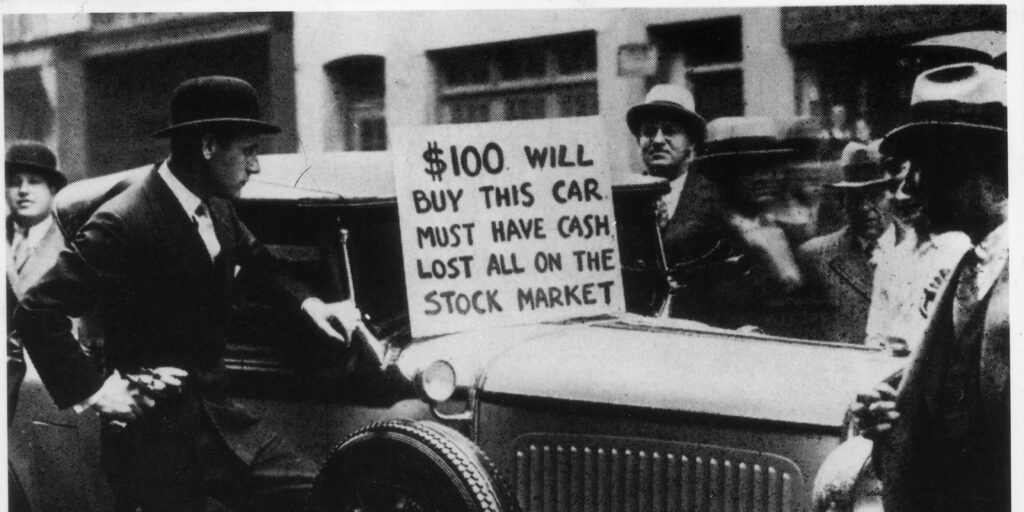
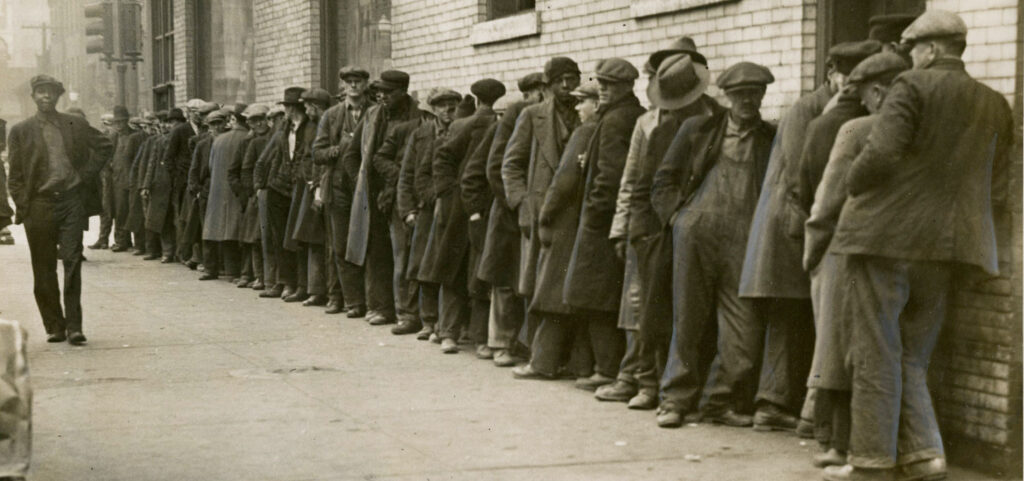
The Stock Market Crash of October 24-29, 1929 is most frequently considered one of the two precipitating events that pushed the United States into the Great Depression, the second being the runs on the banks from 1929 to 1933. While these may have been the outward symptoms, brought on by the massive loss of wealth of the rich and the middle class. They were just symptoms of a fragile economy that developed through the Gilded Age. The middle class was relatively new to market investing and more easily spooked by fluctuations. The panic of these new participants destabilized the typical oscillations of the market creating wider swings up and down inducing further panic. Not helping matters, the general population was aware of how the typical bank operates internally, or how the money stock is utilized locally or nationally.
Contributing Factors
Over investment theories place responsibility on capital over investment by business created a bubble that was unsustainable. Business needed fewer workers as it improved production mechanically by taking on more debt. Fewer jobs and a surplus of workers lowered wages. The country was new to the mass consumer economy, as the job market shrank and incomes dropped, consumers had to reduce personal spending. This let to lower than expected sales for businesses which let to businesses having to contract further to keep up with their debt. This also led to a rapid decline in consumer confidence which contracted consumer spending. So the downward spiral went. Keynesian Theory puts the responsibility on consumer confidence and contracted spending for the contraction of production and the resultant unemployment. Some theorists place responsibility on income disparity, with wealth pooling at the upper class, claiming their contraction as they saw considerable losses in the markets as the cause of further losses. The Product Surplus theory places responsibility on the advancements in technology and capital investments that led to over production, citing the glut as cause for declining prices and profits, leading to lay-offs and contraction. These theories all tie together creating a business-consumer view of what was occurring, but even this was only part of the picture. Much of the remaining picture has to do with the economic controls, or the lack their of.
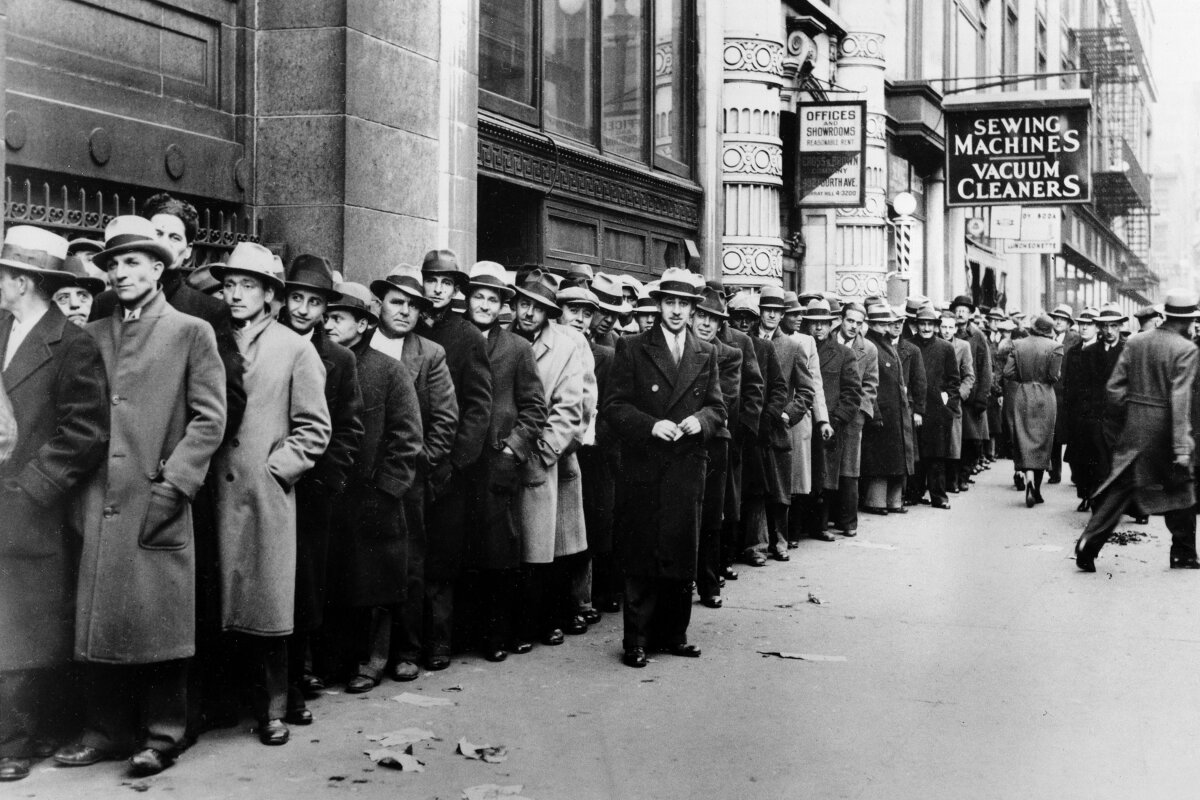
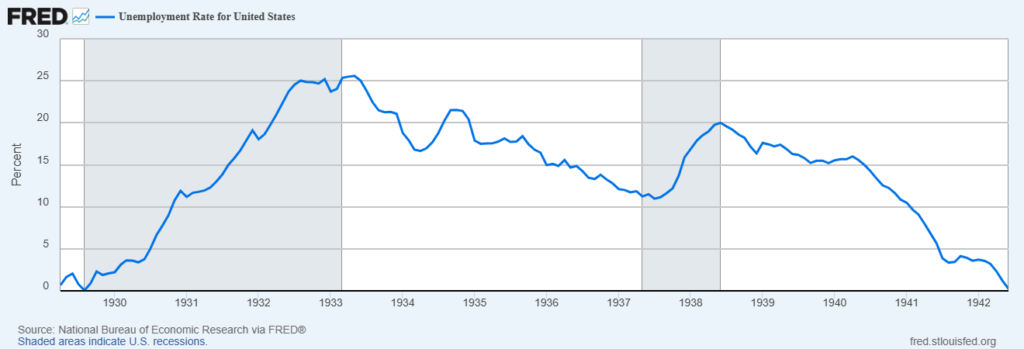
Monetarist theory places responsibility with poor federal monetary policies and the Federal Reserves failures to act or acting inappropriately by not maintaining the money supply and raising interest rates respectively. Protectionism also played a role, the federal government’s institution of the Smoot-Hawley Tariff in 1930. At the depressions peek, the U.S. economy had shrunk 30%, the global economy had shrunk 60% due to Smoot-Hawley. Some theories include the labor pool that had grown through various mechanisms. The labor pool was fare to large with unemployment growing to over 25% at its peek in 1933 and diminishing wages.
National Bureau of Economic Research
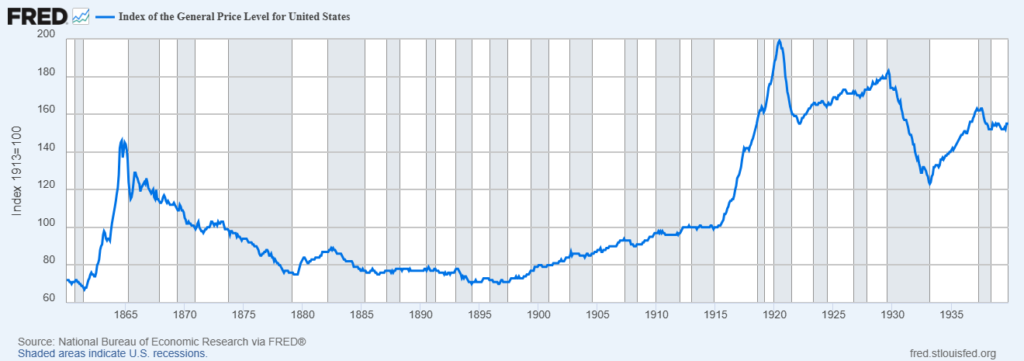
The 1920s saw increases in the cost of goods during the boom before the bust, also with little government engagement. Prices would not drop significantly until 1930.
National Bureau of Economic Research
Recovery
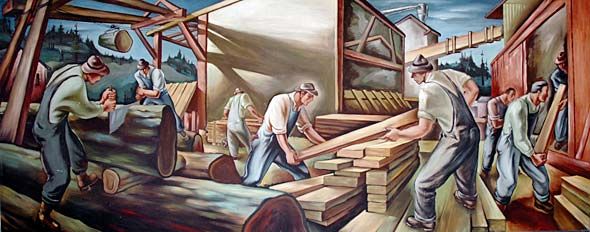
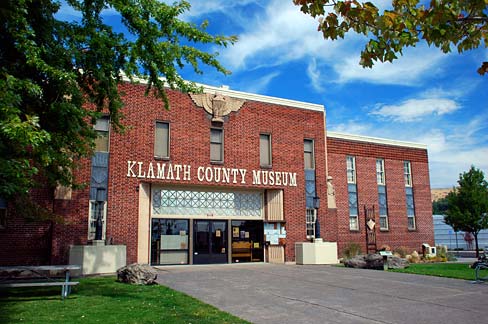
Several things brought about the recovery period, one was the influx of foreign money being transferred to the United States, specifically, foreign gold. As the global economy sank lower than the U.S. economy, assets of overseas wealthy people was transferred to reduce the overall loss. This had a positive effect on the U.S. economy. Prices were beginning to recover, clinched purses were opening, banks still in business began to make loans again. It is important to remember that over 7,000 banks went under from 1929 to 1933. As spending and lending rose, so did employment. A significant portion of this is due to the Works Progress Administration (WPA), part of the New Deal. Many cities still have monuments to the success of the WPA in the form of buildings funded by the WPA. Many of these buildings are in the Art Deco/WPA style. World War II closed out the era with mass employment and government war contracts.
Conclusion
This article is a gross simplification of the complex nature of the Great Depression. Its causes are rooted in the boom of the Gilded Age and poor government over site, planning, and a slow response to the economic crises as they occurred. There are also many other smaller contributing factors not mentioned here.
Sources
McElvaine, Robert S. The Great Depression: America, 1929-1941. Times Books, 1993.
National Bureau of Economic Research, Unemployment Rate for United States [M0892AUSM156SNBR], retrieved from FRED, Federal Reserve Bank of St. Louis; https://fred.stlouisfed.org/series/M0892AUSM156SNBR, February 17, 2026.
National Bureau of Economic Research, Index of the General Price Level for United States [M04051USM324NNBR], retrieved from FRED, Federal Reserve Bank of St. Louis; https://fred.stlouisfed.org/series/M04051USM324NNBR, February 17, 2026.
Wheelock, David. “Why Do We Still Study the Great Depression?.” Federal Reserve Bank of St. Louis, (video, 5:55). Accessed February 17, 2026, https://www.stlouisfed.org/the-great-depression/curriculum/economic-episodes-in-american-history-part-1
Wheelock, David. “Key Economic Terms.” Federal Reserve Bank of St. Louis, (video, 7:03). Accessed February 17, 2026, https://www.stlouisfed.org/the-great-depression/curriculum/economic-episodes-in-american-history-part-2.
Wheelock, David. “How Bad Was the Great Depression? Economic Impact.” Federal Reserve Bank of St. Louis, (video, 3:06). Accessed February 17, 2026, https://www.stlouisfed.org/the-great-depression/curriculum/economic-episodes-in-american-history-part-3.
Wheelock, David. “The Great Recession vs. the Great Depression.” Federal Reserve Bank of St. Louis, (video, 6:25). Accessed February 17, 2026, https://www.stlouisfed.org/the-great-depression/curriculum/economic-episodes-in-american-history-part-4.
Wheelock, David. “What Caused the Great Depression.” Federal Reserve Bank of St. Louis, (video, 9:59). Accessed February 17, 2026, https://www.stlouisfed.org/the-great-depression/curriculum/economic-episodes-in-american-history-part-5.
Wheelock, David. “The Role of Bank Failures and Panics.” Federal Reserve Bank of St. Louis, (video, 11:33). Accessed February 17, 2026, https://www.stlouisfed.org/the-great-depression/curriculum/economic-episodes-in-american-history-part-6.
Wheelock, David. “Where Was the Fed?.” Federal Reserve Bank of St. Louis, (video, 6:48). Accessed February 17, 2026, https://www.stlouisfed.org/the-great-depression/curriculum/economic-episodes-in-american-history-part-7.
Wheelock, David. “What Caused the Recovery?.” Federal Reserve Bank of St. Louis, (video, 3:47). Accessed February 17, 2026, https://www.stlouisfed.org/the-great-depression/curriculum/economic-episodes-in-american-history-part-8.
Wheelock, David. “Lessons Learned and Concluding Remarks.” Federal Reserve Bank of St. Louis, (video, 3:01). Accessed February 17, 2026, https://www.stlouisfed.org/the-great-depression/curriculum/economic-episodes-in-american-history-part-9.