
Two Years and Ten Days

December 1, 2023, was the first post on this site when it was reimagined, and it has been a very busy two years. I started and completed my second master’s, applied and was accepted into a doctoral program, considered withdrawing from the doctoral program, applied for and was accepted into a third master’s program at Johns Hopkins, before deciding to recind my application to that program, and now, waiting for the start of the Spring term to re-engage with the doctoral program already underway. This reengagement was only possible after taking the fall term off to seriously reevaluate whether or not I would continue with this doctorate. In all honesty, the majority of the ‘drama’ has been between last July and September. However, it is official, I am enrolled in the spring term for my last academic class, HIUS 713 American Entrepreneurship Since 1900, and my first dissertation class, HIST 901 Doctoral History Research. I still have three Comprehensive Examination and Reading classes, HIUS 911 Early America, HIUS 912 Modern America, and HIEU 914 Modern Europe, before starting the formal dissertation phase, when I can consider myself a Doctoral Candidate and not just a Doctoral Student.

I have a wide range of interests, which has been both a blessing and a curse. On the positive side, it is relatively easy to shift from one subject to another and to learn new methods for presenting research. It also allows for a broader perspective to view subjects of research. This is great as a student in the academic setting, less so outside the academe. In a time where increasing specialization is the preferred mode, being a generalist can be disadvantageous. On the negative side, falling down a new rabbit hole is all too easy. It can be difficult at times to set the blinders and focus on one thing. This has been a contributing factor in not having fixed on a specific topic for the upcoming dissertation.

As a maker, my perspective on history is often guided by how things were done. Understanding how things were done and how the processes of doing have evolved can open up many avenues of inquiry in the historical record. At the core of making, for me at least, is knowing how things function and how they were made. Thus, my broad interests in machinery, transportation, communications, engineering, architecture, and design. Woodworking is one of the root trades for all of these categories. From Archimedes’ water screw to wind and water mills, wagons & carts, the printing press, early long-distance mechanical visual communications systems, and of course, the shelter and furnishings of our ancestors for thousands of years. Woodworking is also a self-supporting craft with tool-making historically being a key skill learned by the apprentice early on, making their own tools, chests, and benches, all being made in whole or in part from wood.
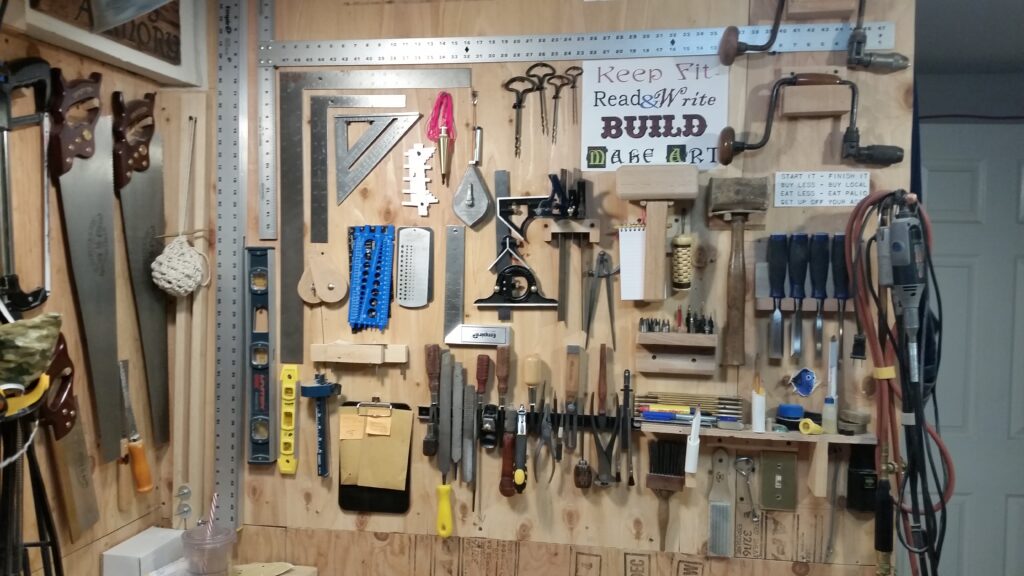
Before moving north from the San Francisco Bay Area to the Klamath Basin, a fair amount of time was spent building a workshop space that focused on bookbinding, restoring old tools, and woodworking.
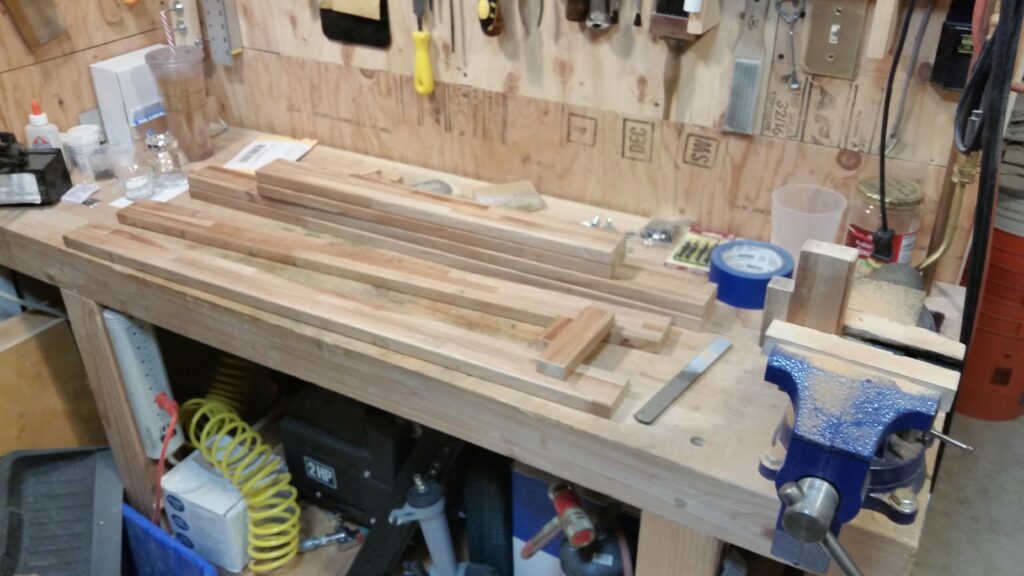
One thing that did not make the move was the workbench. Proper positive workholding is one of the most important keys to effective and safe workshop processes in wood, metal, plastic, or any material. Without a proper workbench since moving, many cherished shop skills have languished in disuse. This week marks a reversal, a new heavy bench is now under construction.
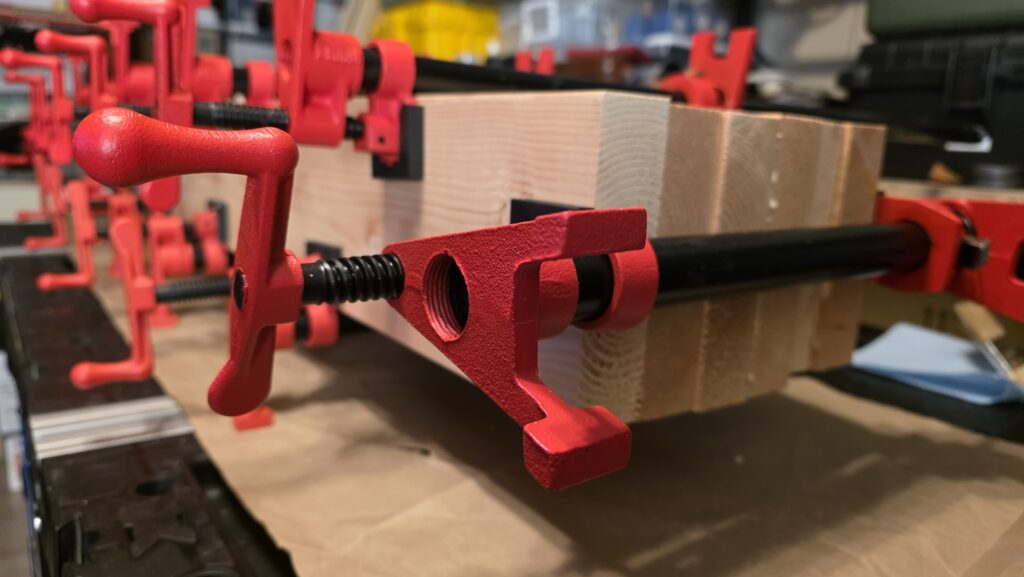
The new bench is an interpretation of the traditional hand tool joiner’s bench. The list of projects that will rely on this bench includes the cabinetry and chests that will replace all of the current shop furniture, making specialized hand tools, making workholding & pressing tools for book repair and binding, and furniture making. Most of these projects will also have a historical component to them, particularly the tool and furniture projects.

One of the concepts under consideration for a dissertation includes developing and employing a framework for Experimental History, using period-appropriate tools and methods to replicate an object of importance to a specific line of research inquiry, whether as an artifact or process. If this concept is to be included in the upcoming dissertation, there will most certainly be a need for tool and pattern making, as well as the construction of the object of inquiry itself. This requires the re-establishment of a working shop, the joiner’s bench being the anchor of the shop.

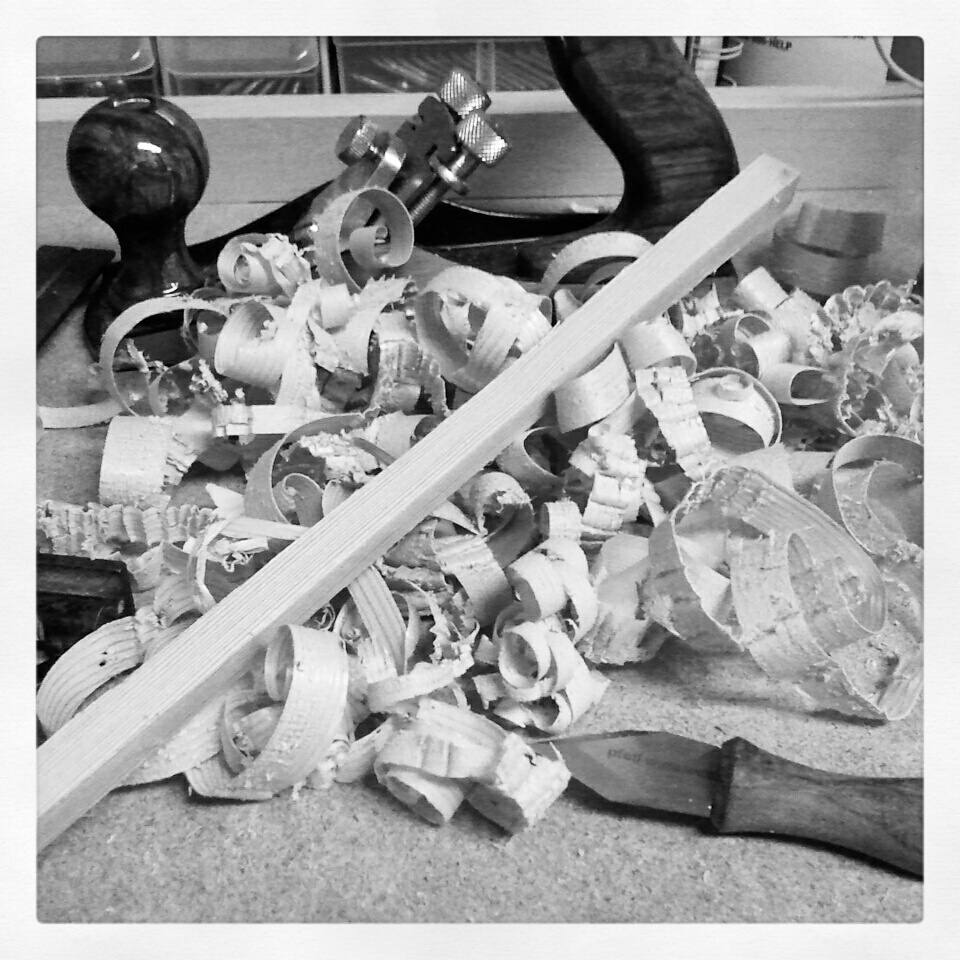
Between shop projects and the possibility of employing Experimental History, the urgency of getting a working hand tool shop up and running is high. To that end, the materials for the bench were acclimating in the shop last week: (10) 2″ x 8″ x 10′ nominal fir construction lumber, and a 6/4 – 14″ x 12′ maple slab. Two days ago, the materials were milled down from nominal lumber to near-dimensional boards, and yesterday, glue-ups started for the major components in rough sizes: (4) legs 5″ x 4″ x 36″, (4) stretchers 5″ x 3″ x 48″, and (1) bench top 5″ x 20″ x 60″. By the end of next week, all of the glue-ups should be done, and final dimensioning can begin. The target size for the bench is a 5″ thick bench top, 20″ deep, 60″ wide, standing 32″ tall, with a 1″ thick fir shelf about 7″ from the floor, inset into the stretchers. The draw-bore mortise and tenon joinery should be all marked out and cut next weekend over the winter solstice. Installation of the mapleface, back, and ends, along with a Moxon-style face vise, tail wagon-vise, the hold-fast and dog holes, and finishing should be done over Christmas week. The plan is to be finished and dressed by January 1st, so work can begin with the new year.
Intentionality II

I applied to Johns Hopkins on July 7th and was accepted on the 17th. My digital presence at the university was processed at a rapid pace, and I had been engrossed in all the preparatory university informational and program-specific reading. I was also focused on completing all of the policy-related training for new students. This occupied the better portion of the week after I was accepted. Then they started to creep into my thoughts, questions.

  • What am I doing?
  • Why am I doing this?
  • Do I need to do this?
  • Does this get me any closer to my goals?
  • How will this affect me in ways I haven’t considered?
  • Why didn’t I consider these questions before now?

This all put me into a contemplative state of mind. I wanted answers to these questions, and more kept coming, so I stopped the new student reading and training and took the afternoon to dig into these questions and assess where this was going. I’ll answer the last question above first because it affects all of the others. I wanted a reputable, secular school on my academic record. It was in many ways a mia culpa for supporting an institution as long as I had. Understanding that motivation and accepting it as truth made it much easier to see the other truths that were to come from this self-reflection.

Truth One. I’m not in my 20s or 30s anymore. That may seem obvious, but honestly, despite the constantly aching knees and restless sleep, I usually feel much younger than I am. I believe that is what has carried me through my academic pursuits of the last seven years.

Truth Two. I don’t want to retire in my 80s. Yikes. At best, I have maybe 20-25 years of useful “work” in me. I would like most of that time to be in a hand tool woodshop or on the water, not worrying about pleasing my 30-year-old boss. Yes, it sounds like a grumpy old guy, and in many ways it is, but it is founded in a lifetime of diverse experience.

Truth Three. I don’t want to be a teacher. It is not that I dislike teaching. On the contrary, I love teaching. I don’t want to teach in the environment created by the current administration. I am also not a fan of the internal politics of the academy. I could see myself teaching part-time as an adjunct, but I would be more fulfilled working on educational programs at a museum. This is where it sunk in that I didn’t want to be a professor.

ETA I have since reconsidered this position to some extent, I do want to teach.

Truth Four. If I am not teaching at the university level, I don’t need a Ph.D. When I started the Ph.D. path, I wanted to teach at the university level. I have to admit, though, that part of the attraction was vanity. To deny that would be untruthful, and this exercise is about truth.

ETA Again, I have reconsidered this position. I do want to teach at the university level; thus, I have reengaged with the doctoral program, taking only one semester off.

Truth Five. I have two master’s degrees. Will a third get me closer to my goals? The short answer is, no, it won’t. In many ways, this answer sucks. I am truly interested in the Cultural Heritage Management program and would rather not withdraw from it. I am so grateful and feel truly blessed that I got into the program. If things were not as they are, I would likely stay in the program just for the edification and enjoyment. Things as they are, I am withdrawing.

Truth Six. My academic career has come to its conclusion. This sounds rather final, almost dark. However, the fact is, I will not be in the academe in a formal sense. I will surely engage with it and may even actively participate in the academe in the future. For now, at least, I am not a student, an instructor, or affiliated with a university. While I am a little sad about that, it is what it is, and I am okay with that.

ETA when I posted this, by academic career, I meant formal academics. However, this too has changed as I return to the doctoral program.

Truth Seven. It’s time to put all of this training to good use. Having taken instruction out of the mix, that leaves public history. There are a lot of directions a historian or public historian can go. Most often, we think of museums and parks, and I had hoped to go in the museum direction. Where we are, geographically, this isn’t a viable direction. Engaging as an independent contractor with governments, businesses, and organizations is the most viable path.

ETA my conciderations here remain. In light of some recent events, I am even more inclined to look for non-local alternatives.

Truth Eight. If I am going to find traditional, institutional employment, it won’t be where we are geographically. There are many parts of the country where a public historian can find work far more easily than in Oregon.

Truth Nine. Doing history and or public history independently is going to require strong self-motivation skills. Like any independent contractor, it’s all on you to make things happen. Fortunately, I have a lot of experience in this.

Truth Ten. Assuming I pursue doing history/public history as an independent contractor, I have a lot of planning and development work to do.

These realizations are split into two tenses, past and present. I needed to see and acknowledge the first six for what they are, so I could process seven on. There is still a lot to do, an understatement to be sure, but it is time to move forward.

ETA I chose to take the fall term off to reflect more on these truths. Very little has changed in the bigger picture. The main change was the decision to return to the doctoral program and finish what I started. My decision is not based on “I’m over half done, I should finish this.” I tuely do want to earn my doctorate in history. While finishing what I started does play a small roll in my decision, it is a very small role. I am committed to this path.

updated December 11, 2025

Confessions

by Jonathan W. Wanzer
July 16, 2025

The first half of 2025 has been quite the year, hasn’t it?

The division among Americans continues to grow deeper. Factions continue to isolate themselves within their narrow information bubbles, willfully ignorant of what is happening outside their limited perspective. We are all developing mental and emotional stress injuries from just trying to get through the next day. Traumas continue to accumulate, exaggerating emotions, shortening attention spans, and fuses alike, which adds to the division and isolation. Many of us have opted to avoid inevitable conflicts by refusing to talk or write about what we were thinking and feeling out of fear, fear of losing or not getting a job, fear of getting kicked out of school, fear of reprisals, vandalism, or worse, violence. Many of us feared the possibility of isolation from families, rejection from the communities we participate in, and some have feared excommunication from their religious communities for being dissenters and conscientious objectors.

I don’t know about you, but I’m exhausted from all of it.

White supremacists and Christian nationalists, under the cover of MAGA, have generated so much hate and fear across the entire nation and beyond, just to further the avarice and ambitions of dominance of a handful of despicable, hateful people who literally couldn’t care less for the people they have persuaded to support them. Lying to their faces and stealing from them, committing their unethical and illicit actions in plain sight without fear of consequences. Their only concerns are self-aggrandizement and profit. Nothing they do is in the country’s best interest, nor the interests of their constituents. Most certainly, none of their actions are remotely Christian in nature. Their actions, and the fear and hate their actions generate, are indeed the antithesis of Christianity. They exist and thrive on fear and hate, there is no love in their actions or their hearts.

Until now, I have been complicit through my silence.

The school I have been attending contributed significantly to the development of Project 2025, and they continue to contribute to the destruction of the United States Constitution and government through their support of MAGA extremists. My complicity was with a heavy heart, but knowing what I was doing, justifying my complicity with the fear of appearing critical of the institution’s politics, prompting retaliation. Late though it is, my limits have been reached; I can no longer bear the shame of silence and inaction. I have applied to another university and a different program. I am hopeful that at some point in the future, I will be able to continue the path of a terminal degree.

My opinions and beliefs will undoubtedly cause some friction, as will my complicity.

Among my ancestors, several lines came to North America in the seventeenth century. They were immigrants. Whether 300 years ago or 3 days ago, they all made a journey of faith, vision, and hope. Immigrants built, and continue to build, this country. Without immigrants, the country would shrivel and die like an inbred genetic experiment. Likewise, the diverse cultures in America should be celebrated, not restricted, regulated, and whitewashed down to a colorless caricature of an America that never was. I am an ally to all the diverse communities that bring so much to the tapestry of American culture, First Peoples, immigrants, LGBTQIA+, and the displaced and forgotten. I support equality in all aspects of life for all communities. We are all siblings in the human family.

My heart breaks thinking about all those who have been alienated, endangered, and those who will die, because of willful ignorance and hate, in service of greed and authoritarian power.

There is no “us” and “them.” The construct of “the other” is a construct of ignorance, borne of fear, that breeds hate. “The other” is a tool of authoritarianism used to divide and alienate people. To dehumanize segments of the population, making it easier to hate and treat people with cruelty. The enemies of America, and indeed all humanity, are not people, the enemies are ignorance, fear, and hate.

The evils among us can be defeated, ignorance can be defeated, face your fears of “the other,” learn about different cultures, get to know people you don’t agree with, participate in your community, and the communities around you.

In love and hope,
~ Jon