World War I, Newspapers, and the CPI


By: Jonathan Wanzer ORCiD 0009-0004-9275-7410
Submitted on: January 30, 2026
Submitted to: Dr. Cervantez – Liberty University
Course: HIUS 713 American Entrepreneurship Since 1900
Chicago Citation:
Wanzer, Jonathan. “World War I, Newspapers, and the CPI.” Historical Interpretations (blog). January 30, 2026. http://wanzer.org/2026/01/world-war-i-newspapers-and-the-cpi/.

Abstract
This post provides a brief history of the newspaper industry. It covers industry growth through the Gilded Age. It introduces George Creel and his relationship with Woodrow Wilson. The creation of the Committee on Public Information. How CPI and Creel disseminated information and sold America on joining the war in Europe. It concludes with the industry recovering post-war.


Postbellum America was experiencing dramatic changes in all areas of life. The newspaper industry was no different; the period from 1830 to 1930 is often referred to as the Golden Age of American newspapers, and many of the industry’s greatest changes in this period took place between 1880 and 1900. Technology improvements introduced mass production presses, faster communication, and broader reach, all of which served the industry’s need to expand and interconnect. The introduction of the penny-press publishing model, the development and rapid growth of newspaper chains, and the consolidation of chains into empires, exemplified by Joseph Pulitzer and William Randolph Hearst, all contributed to the industry’s expansion in this period. Other models were also taking form in this period, such as yellow journalism. Sensationalism, hyperbole, and exaggeration were regular features of the newspaper industry. At the same time, professionalization in journalism and muckraking became growing parts of the industry.

Sensationalism, hyperbole, and exaggeration have always been part of the press. What distinguishes this period is the motivation behind it. While most newspapers had been funded by political parties before this time, they were now commercial interests tied only to the owner’s political interests. Newspapers were just as likely to attack either party if they could sell more papers. If money was coming in, editors would have greater latitude. Professionalism was starting to take root, bringing about the muckrakers, what we would now call investigative journalists. These muckrakers were also given some freedom in whom they went after, especially if it was likely to sell more papers. While politics was still a motivating factor in the media, the economics of the business were of greater concern. The media’s acceptance of sensationalism and hyperbole would set the stage for its usefulness in propaganda dissemination.

George Creel (1876-1953) began his career in the press in 1896 at the Kansas City World as a reporter. He would work at many newspapers and own several before his involvement with Woodrow Wilson’s (1886-1924) re-election campaign in 1916. He had been a Wilson supporter for a while when he met Wilson in 1912, and they had had several conversations on politics and the press before 1916. As a newsman, Creel was well-versed in advertising and the nascent practice of managing public perceptions, which we now recognize as the field of Public Relations. Creel and Wilson would have several conversations during the 1916 campaign where Creel promoted a way to sell the American people on joining the war in Europe. A key part of this would involve the media distribution channel with the greatest reach, newspapers. Several of Wilson’s cabinet members proposed a full media blackout and imposed censorship. Creel advised Wilson, proposing no blackout or censorship, instead, the government would create a clearinghouse that would clear and disseminate government information and requests for information. The press would be expected to sign an agreement that they would submit any articles even tangentially related to the war effort for clearance, and in exchange, they would have a firehose of information to drink from, all pre-cleared through this clearinghouse. With only a few dissenters, mostly in the War Department, Creel’s plan was accepted, and by Executive Order 2594, the Committee on Public Information was formed on April 13, 1917, just seven days after America joined the war in Europe.

The Committee on Public Information (CPI) had two primary responsibilities: to manage and clear for dissemination all information outside of military channels and to the public on the United States involvement in the war in Europe, and to sell the American population on the war. In two weeks after the establishment of the CPI, George Creel had reached out to his media contacts, establishing contact with newspaper owners and editors across the nation to get them to sign agreements with the CPI to clear all internally generated stories. Many of the owners and editors were skeptical about the “article clearance” being just another form of censorship, and they weren’t sure that the CPI could serve so many outlets. By the end of May, a large majority of newspapers had signed the agreement, and the CPI was generating hundreds of articles per day. As the CPI expanded in the weeks to come, it established regional offices around the country to clear articles, provide pre-cleared articles, and generate pre-cleared articles of local and regional interest. In just a couple of months, the CPI was generating thousands of articles a day. They were so successful that the CPI’s scope was expanded on September 25, 1917, to establish divisions for pictures, films, and other publications.

Early in the CPI’s existence, it was outputting thousands of columns of news per day, and it was by far the largest news organization in the country. The content it produced was for the end consumers of news, the American people. It could have become a state-run news organization, which was recognized by the media moguls and small paper owners of the day. They had a few options, but the only option that would not negatively affect their bottom line was to work with the CPI. CPI provided massive amounts of content that could effectively go straight to typesetting. They also had a large variety of topics to choose from. A paper could produce an entire issue from CPI-generated columns alone. Most papers continued to generate content internally, but the volume was considerably reduced, subsequently reducing newsroom costs, all while increasing circulation to wartime readers. Most businesses that bought ad space continued to advertise, though they tended to lean towards patriotic themes in their advertising. After the war, the CPI was abolished in August 1919. At this time, the Associated Press, which was founded in 1846, took its pre-CPI place as the largest news gathering organization in America.

Sources

  • Axelrod, Alan. Selling the Great War: The Making of American Propaganda. Palgrave Macmillan, 2009.
  • Creel, George. How We Advertised America: The First Telling of the Amazing Story of the Committee on Public Information That Carried the Gospel of Americanism to Every Corner of the Globe. Harper & Brothers, 1920.
  • Creel, George. Rebel at Large: Recollections of Fifty Crowded Years. G.P. Putnam’s Sons, 1947.
  • Kingsbury, Celia Malone. For Home and Country: World War I Propaganda on the Home Front. University of Nebraska Press, 2010.
  • Schudson, Michael. Discovering the News: A Social History of American Newspapers. Basic Books, 1978.
  • Smythe, Ted Curtis. The Gilded Age Press, 1865-1900. Praeger, 2003.

A Soft Spot for Newspapers

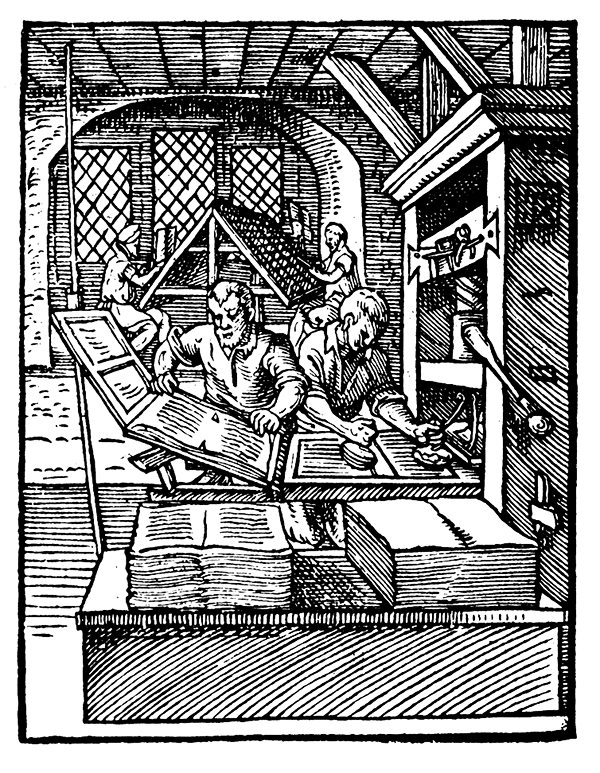
I have always had an affinity for newspapers, the physical medium, more so than the content. In many ways, it is like my affinity for books, the physicality of the medium. As long as I can remember, I have been interested in manual printing presses and the early small-run automated presses of the late 18th and early 19th centuries. I am not much of a journalist, but I have done ad and magazine design work as well as photography, along with the digital processing of text and visual components. Over the last year or so, my affinity for the idyllic small-town press has grown—the kind of paper you might find in Andy Griffith’s Mayberry.

My research on propaganda has me doing background on the history of newspapers in America. The two have been close companions since the introduction of broadsheet media, soon after the invention of the printing press. America’s entire history includes propaganda in newspapers from the colonial period to the present. I have an assignment due Sunday on how the turn of the 20th-century newspaper industry was affected in a business sense by the Committee on Public Information’s engagement with the press in both selling America on the war and disseminating information during the war.

One of the first illusions shattered by this research was the idea of the idyllic small-town paper. When they did exist, they were likely a political or special-interest paper from around 1800-1880. By the 1900s, mass-market press, muckrakers, and yellow journalism were already well established. The press lords began to dominate the newspaper industry shortly after the penny-press movement started in the 1830s. Their reign would continue through the Gilded Age, well into the 1930s.

Aside from bringing historic reality into focus, this research has furthered my interest in the restoration of manual and semi-manual presses from the 19th and early 20th centuries. It is also furthering my interest in producing limited press runs of broadsides. What has been added to my list of potential interests is journalism. Journalism from the perspective of that idyllic small-town newspaper, or just maybe, some contemporary journalism flavored with a bit of sass and humor in the spirit of the younger Franklin brother in Philadelphia.

Spring Term 2026

Last academic class! The B-subterm is about to start, and I am taking my last academic class before venturing into a doctoral dissertation. The class is HIUS 713 American Entrepreneurship Since 1900. It’s not a class that, on the outset, ‘sparks joy.’ Thank you, Marie Kondo. While I do have an interest in economics and how it impacts historical events, it is essentially always involved in historical events in some way. It is not a topic I want to burn a lot of cycles on. I generally acknowledge its position as a factor and how/why it is important to acknowledge, but that’s about it. I am not an economist and have no desire to become one. I am also not in business in a way. When it comes to business and economic theory, I am only interested in the micro level with small businesses and local community economics. I hold great disdain for ‘big business’ and the centralization of business sectors, especially when it comes to finance, the food system, and infrastructure. From my perspective, centralization and the scale of ‘big business’ are the causes of many, if not most, of the problems America faces today. Especially things revolving around the topics of wealth disparity, poverty, inequity, and ignorance.

All of that having been said, I have some thoughts on how I might link entrepreneurialism to my research in propaganda and extremism. Anyone with ideas similar to those expressed in the first paragraph is likely thinking, ‘yeah, no duh. Big business linked to propaganda and extremism, there’s a stretch.’ I could point to Public Relations, Marketing, and Advertising as they are, and cite article after article on market and consumer manipulation, but that’s not interesting for me, and I don’t want to spend my time boring myself. To get the creative juices flowing, I am thinking mass media, its commercial interests, and the conflict of interest between shareholders and journalistic responsibility and integrity. I don’t know just yet if this is the path I will take, but it is a frontrunner.

The D-subterm class is HIST 901 Doctoral History Research. The course summary says “instruction on methodological and interpretive approaches appropriate for doctoral research in the discipline of History.” It is the first class in the dissertation process. I still need to complete my comprehensive reading and examination classes, but this is where the formal discussion on dissertation topics begins. I believe this is also where the dissertation advisor is assigned, and the reading selections for comps are conformed to complement the dissertation topic.

After the three comps classes, and before the formal dissertation classes, there is HIST 890 Historiographic Research, which is also a part of the dissertation phase, and focuses on the bibliography and historiography for the dissertation. After HIST 890, I will be considered ABD and officially a Doctoral Candidate.

  • HIUS 713 American Entrepreneurship Since 1900 (Spring 2026 B)

* Dissertation classes are considered J-Term, and the dissertation advisor/committee decides when the candidate moves from one dissertation class to the next. They are not tied to the calendar like other classes.

I am excited to be moving forward. It feels really close to the end of the process, and at the same time, two more years seems an interminably long time. History, like life, is full of dicotomies such as these. I am still a touch timorous about the comprehensives. The idea of having a huge chunk of reading followed by an essay exam and an oral exam is daunting. I am not a fast reader, and while I have a high comprehension rate, my recall of dates and names can be spotty. I remember stories and concepts well, even intricate ones, and I can convey them well. Specifics, on the other hand, are more difficult. That’s why I take copious notes.

To close this entry, I wanted to share a little about my goals for the year. These are not resolutions, I am not placing any pressure on myself to complete them. They are things I would like to do, as time permits:

  • Family: Find ways to spend more downtime or shared-time with family
  • School: Hold a steady pace moving forward, and take weekends off
  • Work: Keep work as-is, no additional responsibilities or obligations
  • Hobbies: Spend time woodworking every week
  • Linguistics: Learn Old English

I recognise that learning Old English to the level I would like will be time-consuming and take more than one year. My goal for this year is to be able to start reading Bēowulf without having to look up every other word. I do have a long-term linguistics plan in mind: Old English followed by Old Norse to begin with. If I do well with OE and make good headway with ON, I may expand on this list. If I don’t, well, that’s okay too. Even though I am long in the tooth, I would like to learn more languages, most of which are ancient too. We will see how it goes.

AI generated with Adobe Firefly. Prompt: In the style of Dutch masters, an old man, white hair and beard, a professor, writing in a journal with fountain pen, 1914 American cloths, sitting at large oak desk. Desk illuminated by Tiffany desk lamp, 3/4 full bottle of burbon, rocks-glass of burbon on desk. Room is a dimmly lit study with bookcases, lots of old books, a large floor stand globe, low stacks of books on desk and floor, a tall window with the image of thomas aquinas in stained glass. Entire room is visibal.

Low-Background AI

Low-Background Steel AI is a term used by John Graham-Cumming[1] that draws from the terminology and practice of the recovery of steel manufactured before the Trinity nuclear tests that began in 1945. The recovery of pre-test steel was necessary because the known background radiation present in steel manufactured before 1945 was a relative constant. After Trinity testing began, the background radiation in steel was contaminated on a worldwide scale. Developing and manufacturing sensitive radiological test equipment required Low-Background Steel with predictable radiological properties. Equipment manufactured with post-Trinity steel would be unreliable due to the unstable background radiation. This condition persisted throughout the Cold War period and beyond. Some time, well after the Limited Nuclear Test Ban Treaty of 1963 had been signed, background radiation levels began to normalize, making the practice unnecessary around 2008. There is a correlation between the Trinity tests and the advent of AI in November 2022. Since then, text, photographic, and video sources have become contaminated by AI. The proliferation of “AI slop”[2] has been accelerating at an alarming pace ever since and can be readily seen on social media platforms across the internet, and is not limited to social media. Thus, Low Background AI is material created before November 2022, when content was human created.

Cash Grab or Propaganda

This is not the first time concerns like those posed by post Low-Background AI have arisen. Leaders of political and religious movements have often set out to intentionally purge human created material that presented an ideological opposition to their movements throughout human history. In fact, it has been a common trait in individuals and movements that not only seek victory, they also seek to obliterate the memory of their perceived enemy, to change history, to silence challenges to their version of history, and to commit cultural genocide. From the burning of the Temple of Artemis by Herostratus (356 BCE), the British burning of Benin City (1897), Mao’s destruction of ancient temples (1966-1976), Nazi destruction of Jewish heritage and art (1933-1945), to the modern destruction of heritage sites at Palmyra and Nimrud by ISIS (2015). The difference between these past atrocities and AI lies in scope, speed, and intention. The scope is worldwide and in all accessible mediums. The speed is frighteningly fast and without precedent. AI slop is on track to outpace human submissions on several platforms in a short time. According to The Guardian,[3] over 20% of the videos YouTube’s algorithm shows to new users is AI slop. “The video-editing company Kapwing surveyed 15,000 of the world’s most popular YouTube channels – the top 100 in every country – and found that 278 of them contain only AI slop.”[4] Which brings us to the third difference, intention. While much of the AI-generated slop is purely for profit,[5] there are other motivators. In today’s mixed-slope market, money, attention, and ideology are the dominant motivators. Slop is used extensively in disinformation and propaganda campaigns on social media because it is a fast, easy, and cheap way to get agenda messaging into the wild[6] with little attention being paid to dispute claims, and there is the sheer volume of slop being pushed, saturation of the message is all but guaranteed, regardless of fact-checking and follow-up refutation.

Ready for Primetime?

OpenAI flipped the switch on April 10, 2025, turning on ChatGPT’s ambient memory training model, placing you, the user, as part of the AI’s training by remembering personal details about you, the user, to predict how you will act in your use of the AI. This goes well beyond using generative AI tools to help edit a photo or video that you create, or searching for synonyms, or rewriting a particular phrase in a manuscript. It sets up the conditions for an unrestrained, active learning environment. When AI has the opportunity to choose its learning data, is unrestrained, or is given an unsuitable dataset for learning, the results have not been good. From ChatGPT being involved in murder and suicide cases, Replit rewriting code and lying about it, Grok becoming a white supremacist, MyCity encouraging illegal activities, ChatGPT AI “authors” writing factually incorrect articles, and a wide range of reports where AI agents created or referenced data that never existed, it is clear that there are significant issues with the technology.[7] This begs the question, why? Why are tech companies so invested in forcing AI on the general population? What is the motivation for AI being used for content generation? What is the justification for providing such powerful tools to trolls and provocateurs?

A Reckoning

There is a bright spot on the horizon. AI slop has been pushed so hard by opportunistic revenue generators and ideological provocateurs that a majority of potential consumers on social media have grown tired of AI’s proliferation and are paying less attention to AI-generated content. To be sure, there are still niche markets for this kind of ideological propaganda. In conspiracy theory spaces, AI materials are consumed voraciously, but these are much smaller consumer bases. The general population’s attention, though initially captured, seems to be developing a resistance to further inculcation.[8] The backlash has already begun. Conversation on AI-generated content proliferates public discourse online and off, including concerns over intellectual property rights, and the dangers and ease of the rapid deployment of disinformation. Somewhat in line with the Skynet discussion of physical dangers posed by autonomous AI systems,[9] there are tangible issues with AI, cognitive offloading, and potential for cognitive decline in humans are major concerns. Sat Singh proposes in his TEDx presentation[10] that there is something we can do to prevent cognitive decline due to AI: Resist Unthinking, or resist offloading our thinking responsibilities, and spend time actively building cognitive skills. When given the option, decline to use AI tools to create content, or any other task you can do yourself.

What This Means for History and Historians

Historians must recognize that this is a period of unreliable sources. Until the long-term effects of the early age of AI are known and understood, all content and information created in this time should be considered unreliable as fact or as an account of events for future historians producing historical content of this period. Without clear provenance, provable data integrity of photographs, audio, and video, without eyewitness documentation, the ability to discern fact from AI fiction is not possible. Historians and archivists in this period must pay particular attention to including metadata and documentation on the authenticity of their work and their sources. Exhaustive sourcing of anything produced in this period must be a primary concern if the facts and truthful accounts of this period are to make the journey into the future. Historians face an unprecedented task; we know, without reservation, our data will and rightfully should be suspect. We must include the tools future historians will need to sus out fact from AI fiction.


[1] Ben J. Edwards, “Scientists once hoarded pre-nuclear steel: now we’re hoarding pre-AI content,” ARS Technica, June 10, 2025, https://arstechnica.com/ai/2025/06/why-one-man-is-archiving-human-made-content-from-before-the-ai-explosion/.

[2] Anna Furman, “Merriam-Webster’s word of the year for 2025 is AI ‘slop’,” PBS News, December 15, 2025, https://www.pbs.org/newshour/nation/merriam-websters-word-of-the-year-for-2025-is-ais-slop.

[3] Aisha Down, “More than 20% of videos shown to new YouTube users are ‘AI slop’, study finds,” The Guardian, December 27, 2025, https://www.theguardian.com/technology/2025/dec/27/more-than-20-of-videos-shown-to-new-youtube-users-are-ai-slop-study-finds.

[4] Emphasis added by author

[5] Ann-Derrick Gaillot and Anna Amarotti, “What the Rise of AI Slop Means for Marketers,” Meltwater, November 27, 2025, https://www.meltwater.com/en/blog/ai-slop-consumer-sentiment-social-listening-analysis.

[6] Kevin Collier, “Large online propaganda campaigns are flooding the internet with ‘AI slop,’ researchers say: Researchers at Graphika say that online propaganda campaigns have flooded the internet with low-quality, AI-generated content,” NBC News, November 19, 2025, https://www.nbcnews.com/tech/security/online-propaganda-campaigns-are-using-ai-slop-researchers-say-rcna244618.

[7] Thor Olavsrud, “10 famous AI disasters,” CIO, December 17, 2025, https://www.cio.com/article/190888/5-famous-analytics-and-ai-disasters.html.

[8] Chase Varga, “AI Slop: When the Internet Drowns in Synthetic Junk,” ListenFirst, September 9, 2025, https://www.listenfirstmedia.com/ai-slop/.

[9] Michael LaBossiere, “Sci-Fi AI: Skynet Threat,” Florida Agricultural and Mechanical University, Accessed December 30, 2025, https://www.famu.edu/academics/cypi/hewlett-cyber-policy-institute-blog/sci-fi-ai-skynet-threat.php.

[10] Sat Singh, “AI, Skynet, and why humans are losing the battle,” TEDx Rancho Mirage, September 4, 2025, https://www.youtube.com/watch?v=oYG2kFC2_D4.

The featured image for this article was AI generated using Adobe Firefly.
The prompt was “A photo-realistic visual representation of an AI writing a non-fiction book about the dangers of using AI to create propaganda disinformation.”