Monday next is the first day of my first dissertation class. The object of the course is to prepare the candidate to complete Chapter One of their dissertation. This morning, I added Manipulating the Masses to my current reading list.1 Hamilton’s book is considered the state-of-the-field academic work on the origins of modern American propaganda. My current class is the first in the dissertation series (HIST901) and focuses on Chapter One. I have academic questions and a hypothesis, but I need to read and thoroughly digest Manipulating the Masses, along with its notes and citations, to develop a solid historiographical picture to begin my literature review. I had an email exchange with Hamilton, and he asked to see my working bibliography, which I posted (here). He thought I had a solid foundation for my research and offered a couple of additional suggestions, so I am confident I am headed in the right direction. The question now is, what will my dissertation adviser think?
I started a dissertation research journal yesterday. I also started re-reading Kate Turabian’s Writer’s Guide, which happens to be the course textbook.2 For now, I will focus on a slow read through Manipulating the Masses over 600 pages and keep a question log for Dr. Hamilton if the need arises. The next dissertation class isn’t for a few months yet, so there is plenty of time to develop a historiography and literature review.
Hamilton, John Maxwell. Manipulating the Masses: Woodrow Wilson and the Birth of American Propaganda. Louisiana State University Press, 2024. ↩︎
Turabian, Kate L. A Manual for Writers of Research Papers, Theses, and Dissertations: Chicago Style for Students and Researchers. 9th edition. University of Chicago Press, 2018. ↩︎
Last academic class! The B-subterm is about to start, and I am taking my last academic class before venturing into a doctoral dissertation. The class is HIUS 713 American Entrepreneurship Since 1900. It’s not a class that, on the outset, ‘sparks joy.’ Thank you, Marie Kondo. While I do have an interest in economics and how it impacts historical events, it is essentially always involved in historical events in some way. It is not a topic I want to burn a lot of cycles on. I generally acknowledge its position as a factor and how/why it is important to acknowledge, but that’s about it. I am not an economist and have no desire to become one. I am also not in business in a way. When it comes to business and economic theory, I am only interested in the micro level with small businesses and local community economics. I hold great disdain for ‘big business’ and the centralization of business sectors, especially when it comes to finance, the food system, and infrastructure. From my perspective, centralization and the scale of ‘big business’ are the causes of many, if not most, of the problems America faces today. Especially things revolving around the topics of wealth disparity, poverty, inequity, and ignorance.
All of that having been said, I have some thoughts on how I might link entrepreneurialism to my research in propaganda and extremism. Anyone with ideas similar to those expressed in the first paragraph is likely thinking, ‘yeah, no duh. Big business linked to propaganda and extremism, there’s a stretch.’ I could point to Public Relations, Marketing, and Advertising as they are, and cite article after article on market and consumer manipulation, but that’s not interesting for me, and I don’t want to spend my time boring myself. To get the creative juices flowing, I am thinking mass media, its commercial interests, and the conflict of interest between shareholders and journalistic responsibility and integrity. I don’t know just yet if this is the path I will take, but it is a frontrunner.
The D-subterm class is HIST 901 Doctoral History Research. The course summary says “instruction on methodological and interpretive approaches appropriate for doctoral research in the discipline of History.” It is the first class in the dissertation process. I still need to complete my comprehensive reading and examination classes, but this is where the formal discussion on dissertation topics begins. I believe this is also where the dissertation advisor is assigned, and the reading selections for comps are conformed to complement the dissertation topic.
After the three comps classes, and before the formal dissertation classes, there is HIST 890 Historiographic Research, which is also a part of the dissertation phase, and focuses on the bibliography and historiography for the dissertation. After HIST 890, I will be considered ABD and officially a Doctoral Candidate.
HIUS 713 American Entrepreneurship Since 1900 (Spring 2026 B)
HIST 901 Doctoral History Research (Spring 2026 D)
HIUS 911 Early America (Summer 2026)
HIUS 912 Modern America (Fall 2026)
HIEU 914 Early Modern Europe (Fall 2026)
HIST 890 Historiographic Research (Spring 2027)
HIST 987 Dissertation I (Spring 2027*)
HIST 988 Dissertation II (Summer 2027*)
HIST 989 Dissertation III (Fall 2027*)
HIST 990 Dissertation Defense (Winter 2027*)
* Dissertation classes are considered J-Term, and the dissertation advisor/committee decides when the candidate moves from one dissertation class to the next. They are not tied to the calendar like other classes.
I am excited to be moving forward. It feels really close to the end of the process, and at the same time, two more years seems an interminably long time. History, like life, is full of dicotomies such as these. I am still a touch timorous about the comprehensives. The idea of having a huge chunk of reading followed by an essay exam and an oral exam is daunting. I am not a fast reader, and while I have a high comprehension rate, my recall of dates and names can be spotty. I remember stories and concepts well, even intricate ones, and I can convey them well. Specifics, on the other hand, are more difficult. That’s why I take copious notes.
To close this entry, I wanted to share a little about my goals for the year. These are not resolutions, I am not placing any pressure on myself to complete them. They are things I would like to do, as time permits:
Family: Find ways to spend more downtime or shared-time with family
School: Hold a steady pace moving forward, and take weekends off
Work: Keep work as-is, no additional responsibilities or obligations
Hobbies: Spend time woodworking every week
Linguistics: Learn Old English
I recognise that learning Old English to the level I would like will be time-consuming and take more than one year. My goal for this year is to be able to start reading Bēowulf without having to look up every other word. I do have a long-term linguistics plan in mind: Old English followed by Old Norse to begin with. If I do well with OE and make good headway with ON, I may expand on this list. If I don’t, well, that’s okay too. Even though I am long in the tooth, I would like to learn more languages, most of which are ancient too. We will see how it goes.
AI generated with Adobe Firefly. Prompt: In the style of Dutch masters, an old man, white hair and beard, a professor, writing in a journal with fountain pen, 1914 American cloths, sitting at large oak desk. Desk illuminated by Tiffany desk lamp, 3/4 full bottle of burbon, rocks-glass of burbon on desk. Room is a dimmly lit study with bookcases, lots of old books, a large floor stand globe, low stacks of books on desk and floor, a tall window with the image of thomas aquinas in stained glass. Entire room is visibal.
December 1, 2023, was the first post on this site when it was reimagined, and it has been a very busy two years. I started and completed my second master’s, applied and was accepted into a doctoral program, considered withdrawing from the doctoral program, applied for and was accepted into a third master’s program at Johns Hopkins, before deciding to recind my application to that program, and now, waiting for the start of the Spring term to re-engage with the doctoral program already underway. This reengagement was only possible after taking the fall term off to seriously reevaluate whether or not I would continue with this doctorate. In all honesty, the majority of the ‘drama’ has been between last July and September. However, it is official, I am enrolled in the spring term for my last academic class, HIUS 713 American Entrepreneurship Since 1900, and my first dissertation class, HIST 901 Doctoral History Research. I still have three Comprehensive Examination and Reading classes, HIUS 911 Early America, HIUS 912 Modern America, and HIEU 914 Modern Europe, before starting the formal dissertation phase, when I can consider myself a Doctoral Candidate and not just a Doctoral Student.
I have a wide range of interests, which has been both a blessing and a curse. On the positive side, it is relatively easy to shift from one subject to another and to learn new methods for presenting research. It also allows for a broader perspective to view subjects of research. This is great as a student in the academic setting, less so outside the academe. In a time where increasing specialization is the preferred mode, being a generalist can be disadvantageous. On the negative side, falling down a new rabbit hole is all too easy. It can be difficult at times to set the blinders and focus on one thing. This has been a contributing factor in not having fixed on a specific topic for the upcoming dissertation.
As a maker, my perspective on history is often guided by how things were done. Understanding how things were done and how the processes of doing have evolved can open up many avenues of inquiry in the historical record. At the core of making, for me at least, is knowing how things function and how they were made. Thus, my broad interests in machinery, transportation, communications, engineering, architecture, and design. Woodworking is one of the root trades for all of these categories. From Archimedes’ water screw to wind and water mills, wagons & carts, the printing press, early long-distance mechanical visual communications systems, and of course, the shelter and furnishings of our ancestors for thousands of years. Woodworking is also a self-supporting craft with tool-making historically being a key skill learned by the apprentice early on, making their own tools, chests, and benches, all being made in whole or in part from wood.
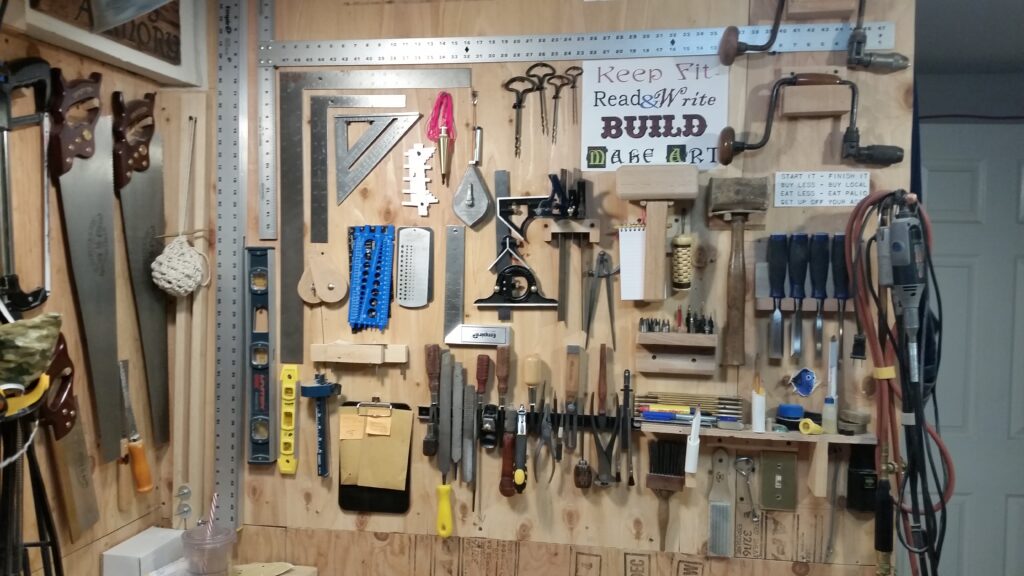
Before moving north from the San Francisco Bay Area to the Klamath Basin, a fair amount of time was spent building a workshop space that focused on bookbinding, restoring old tools, and woodworking.
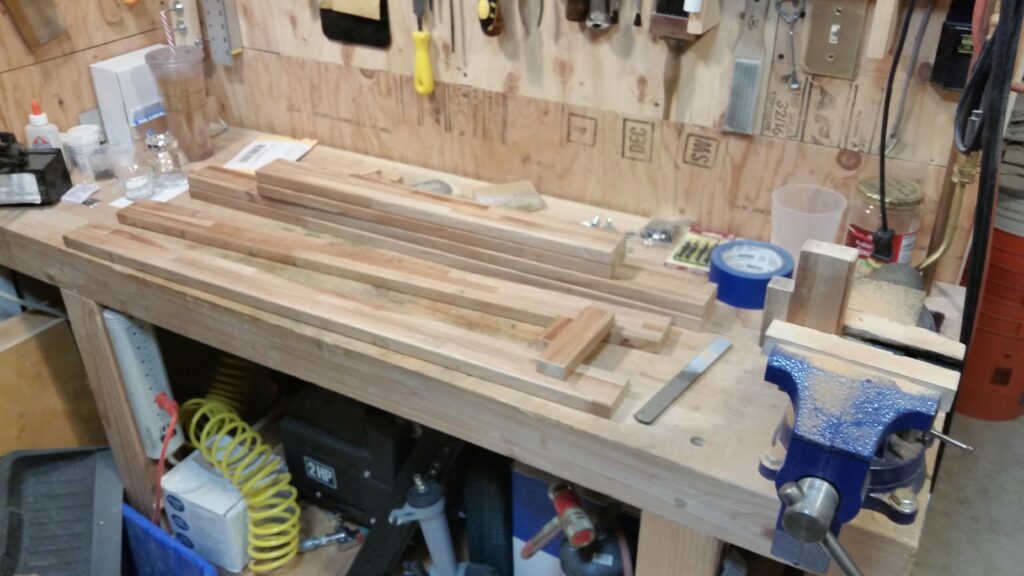
One thing that did not make the move was the workbench. Proper positive workholding is one of the most important keys to effective and safe workshop processes in wood, metal, plastic, or any material. Without a proper workbench since moving, many cherished shop skills have languished in disuse. This week marks a reversal, a new heavy bench is now under construction.
The new bench is an interpretation of the traditional hand tool joiner’s bench. The list of projects that will rely on this bench includes the cabinetry and chests that will replace all of the current shop furniture, making specialized hand tools, making workholding & pressing tools for book repair and binding, and furniture making. Most of these projects will also have a historical component to them, particularly the tool and furniture projects.
One of the concepts under consideration for a dissertation includes developing and employing a framework for Experimental History, using period-appropriate tools and methods to replicate an object of importance to a specific line of research inquiry, whether as an artifact or process. If this concept is to be included in the upcoming dissertation, there will most certainly be a need for tool and pattern making, as well as the construction of the object of inquiry itself. This requires the re-establishment of a working shop, the joiner’s bench being the anchor of the shop.
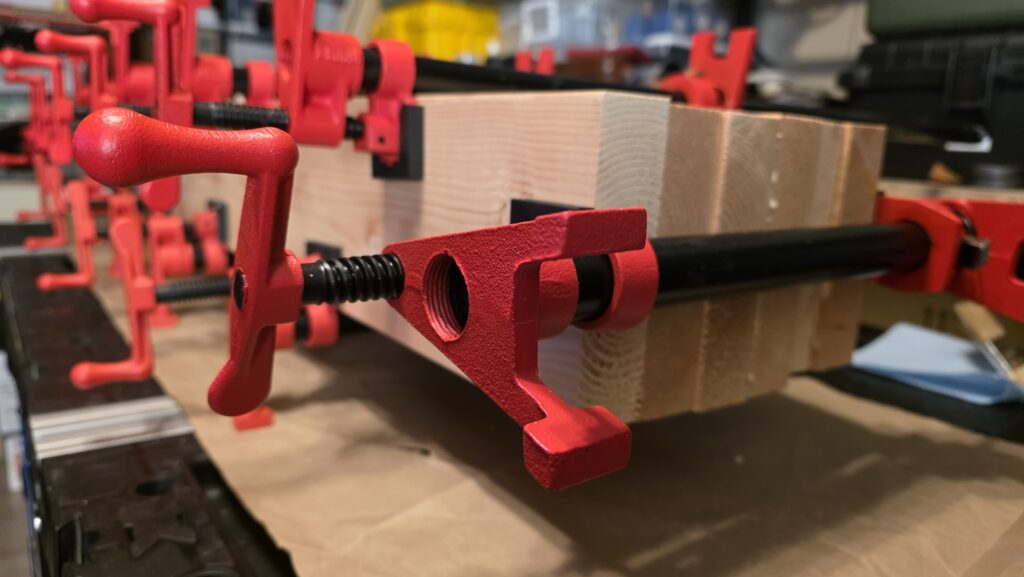
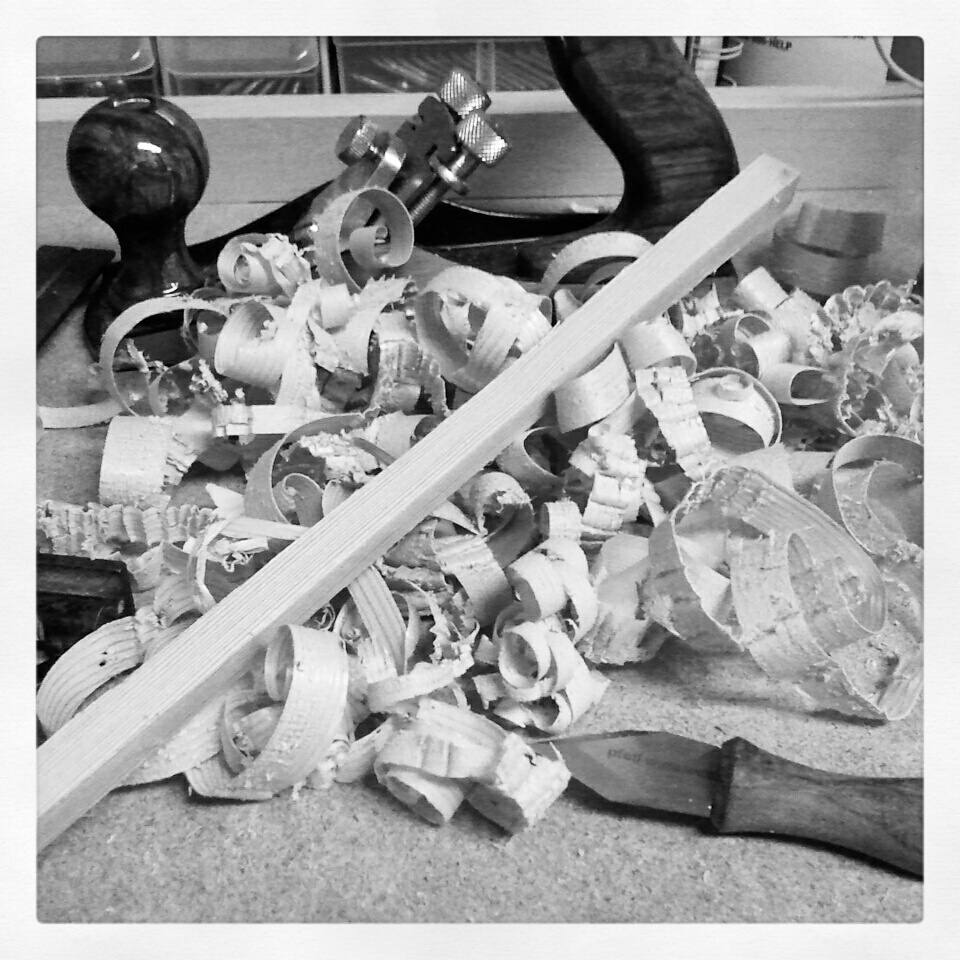
Between shop projects and the possibility of employing Experimental History, the urgency of getting a working hand tool shop up and running is high. To that end, the materials for the bench were acclimating in the shop last week: (10) 2″ x 8″ x 10′ nominal fir construction lumber, and a 6/4 – 14″ x 12′ maple slab. Two days ago, the materials were milled down from nominal lumber to near-dimensional boards, and yesterday, glue-ups started for the major components in rough sizes: (4) legs 5″ x 4″ x 36″, (4) stretchers 5″ x 3″ x 48″, and (1) bench top 5″ x 20″ x 60″. By the end of next week, all of the glue-ups should be done, and final dimensioning can begin. The target size for the bench is a 5″ thick bench top, 20″ deep, 60″ wide, standing 32″ tall, with a 1″ thick fir shelf about 7″ from the floor, inset into the stretchers. The draw-bore mortise and tenon joinery should be all marked out and cut next weekend over the winter solstice. Installation of the mapleface, back, and ends, along with a Moxon-style face vise, tail wagon-vise, the hold-fast and dog holes, and finishing should be done over Christmas week. The plan is to be finished and dressed by January 1st, so work can begin with the new year.
Some time ago, before or around 2015, I saw a documentary following the journey of an archaeologist who wanted to answer the question, could the Vikings have been the first Europeans to land in North America? From a navigational perspective, the Polynesians have been navigating the Pacific for centuries, there is no reason to doubt that the Norse seafaring people had some similar skill. Unfortunately, there isn’t a definitive navigational tradition that has been passed down through Norse legend, but we can see it as a possibility. The next question is, could their vessels have made transatlantic crossings? This is a question that can be answered, Viking ships have been located and unearthed. It is known what they looked like and how they were constructed, there are examples available for reference. Likewise, there are references for the tools they had. To answer the question if it was possible, a ship would have to be built from materials like those available, with tools they had according to the historical record, and techniques evident in the example ships available. Assembling a team of woodworkers and sailors they embarked on building a historically accurate, to a reasonable degree at least, Viking ship. The process of building the ship provided a lot of insight into the process and provided some answers to questions about the building process. On completion of the build, the vessel was eventually sailed from Scotland to Newfoundland by way of Iceland and Greenland in an epic North Sea adventure. This was one of the first documented Experimental Archaeology enterprises. It was also the inspiration for some of the paths I have chosen over the years.
The Viking adventure above was a big project that took years to accomplish, had a good-sized team, and had a sizable price tag. It would be great to consider myself an archaeologist, and it is not completely out of the realm of possibility if I were to approach it from the experimental history direction. The concept of experimental archaeology is very appealing to a maker with a broad range of skills. As a historian, the thought of bringing more experimentation into the process is exciting. This post is inspired questions posed to one of my professors floating this idea of experimental history and his incouraging responses.
I prefaced my questions with this…
“My thoughts on the differentiation between the two fields are that experimental archaeology would involve fieldwork and unknowns whereas experimental history would be more of an archive-to-lab/workshop affair to reproduce a known to illustrate the function and operation.“
“As an amateur radio license holder, I am passionate about radio communications, and communications technologies in general. My vision of experimental history is conducting historical research and building the equipment that either no longer exists or is so rare that replicas or reproductions are the most practical path forward, documenting the process, and conducting operational experiments with the end goal of producing historical documentary products, papers, articles, books, documentary films, and exhibits. The technologies I am most interested in are the early forms of the electric telegraph through radiotelegraphy and the early forms of telegraphic printing to radioteletype.“
Is there a path to experimental history as a field, or is it too close to experimental archaeology?
“I think so, and I’d love to have you consider it.“
If it seems like it could be a distinct field, how does one promote a field like this?
“Maybe, but I don’t know. …Feel free to do research on items of interest, working on a functional model for experimental history“
Clarifying later in another email he said “I used the expression “functional model…” because this is a novel concept. … As you work on projects, you can refine your thinking and present this as a legitimate approach to dissertation research.“
What are your general thoughts on the concept?
He liked the idea of “experimental history” and would be happy to see this in practice noting that it would “draw heavily on historical sources and methodologies, albeit with some specialized skills” which I agree with entirly.
Also in a later email he said “As you think about “experimental history,” you will want to consider research approaches and methodologies that you would use in your dissertation research.“
This is all very encouraging, it also is a paradigm that affects my current class and well beyond, it could mean a significant shift in my dissertation topic. To what degree is yet to be determined, but it is clear I have a considerable amount of thinking to do.