
By: Jonathan Wanzer ORCiD 0009-0004-9275-7410
Submitted on: February 11, 2026
Submitted to: Dr. Cervantez – Liberty University
Course: HIUS 713 American Entrepreneurship Since 1900
Chicago Citation:
Wanzer, Jonathan. “Robert McCormick and the Chicago Tribune.” Historical Interpretations (blog). February 11, 2026. http://wanzer.org/2026/02/robert-mccormick-and-the-chicago-tribune/.
Abstract
This post discusses the life of Robert Rutherford McCormick and his ascendance to President of the Chicago Tribune. It includes his youth and major life events. It provides some insight into his military service. It outlines his newspaper industry experience. The article concludes with his legacy in the newspaper and media industry.
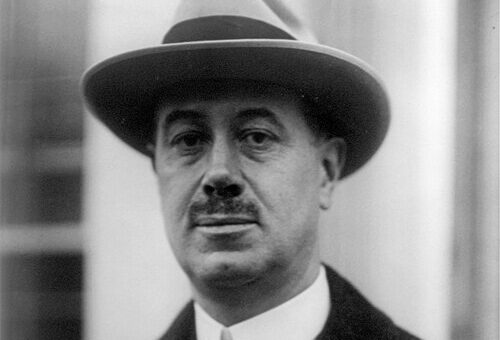
Robert Rutherford McCormick, also known as The Colonel or Colonel McCormick, a rank he earned in the U.S. Army, was born in Chicago, IL, on July 30, 1880, the second son of US Ambassador Robert Sanderson McCormick and Katherine Medill McCormick, daughter of Joseph Medill, who, with five partners, bought the Chicago Tribune in 1855. When he was 9, his father was serving in the diplomatic corps in London. It is in this period that he taught himself to sail and developed his strong sense of self and self-confidence. He had a strong will and exhibited an adventurous spirit. Back in the States, he attended the Groton prep school, where he was described as above average but lacking in motivation. Despite the apparent lack of motivation, he did well enough to get into Yale, where he found his motivation. He was also able to exercise his adventurous nature in hunting in the Hudson Bay area with Inuit guides. Back in Chicago after graduating from Yale in 1903, he decided to go to law school at Northwestern.
This was also a period of political exploration for Robert. Elected as an Alderman and president of the Chicago Sanitary District. He was known for his platform of honest government and willingness to dig in and do the difficult work and not tolerating political hacks on his staff. His conservative views would continue throughout his life, generally opposed to progressives, the New Deal, and the U.S. entry into WWII.
In 1906, his future was on shifting sands. His older brother, Medill, had a nervous breakdown. Medill had been groomed to take over the Tribune at some point. In 1910, Medill and Robert’s uncle, Robert Patterson, editor-in-chief and president of the Tribune, died. The uncertainty of the newspaper’s management put the future of the Tribune in jeopardy. The board was even considering selling the Tribune. In 1911, Robert Rutherford McCormick took the reins of the Tribune, calming the board and stabilizing the business.
Now in his thirties, Robert married Amy Irwin Adams in 1915. True to his adventurous spirit and patriotism, the young couple’s honeymoon would not be a typical one. The couple toured war-torn Europe with Robert writing about the experience along the way. Later that year, home from Europe, Robert felt he needed to do more for his country and enlisted in the Illinois National Guard. He was deployed to protect the southern border to protect the country from Pancho Villa’s raids. In 1917, he signed up for the American Expeditionary Forces and served in France. He earned his Colonel rank in 1918 and a Distinguished Service Medal in 1923, staying a reservist until 1929.
Robert R. McCormick became the sole editor-in-chief in 1925 and would lead the Tribune for five decades, building a media empire including three major papers, the Chicago Tribune, Washington Times-Herald, and New York Daily News, a radio station WGN (1924), and a TV station, also with the WGN callsign (1948). The callsigns stood for World’s Greatest Newspaper, showing his enthusiasm and dedication. The Tribune was a paragon of an institution. Its employees were among the highest paid. They respected the Colonel, and he, in return, respected them. McCormick went to great lengths to ensure the success of the Tribune Company, the parent company that ran the various media outlets, engaging in forestry, buying paper mills, investing in hydroelectric, and shipping companies to provide support services and distribution.
Robert R. McCormick was a leader in the field of journalism, and under his direction, the Tribune would have the largest circulation of all American standard-sized newspapers. It would also lead the world in newspaper advertising revenue. His editorials were known for expressing his conservative journalistic integrity. He was an adamant defender of the First Amendment and Freedom of the Press. One of his primary goals as a journalist was to lay the foundation for journalism to become a bona fide profession. To that end, he introduced the concept of higher education in journalism and helped establish Northwestern’s Medill School of Journalism and provided initial and ongoing funding for the school.
In 1939, the Colonel’s wife, Amy, died. He remarried in 1944 to a close friend of Amy’s, Maryland Mathison Hooper. The Colonel died on April 1, 1955, in Wheaton, Illinois, at the age of 74, survived by his second wife, Mary. Robert Rutherford McCormick was a publisher, editor, media pioneer, war hero, explorer, public servant, civic leader, attorney, and a true philanthropist. He established the Robert R. McCormick Charitable Trust, which turned his 500-acre estate, Cantigny, named after the village, where he served in France in WWI, into a funded public park. The trust also funds early childhood education programs in Chicago and community programs in the South and West sides of Chicago.
Robert R. McCormick was a privileged man. Born into a generationally wealthy family, well-traveled, and well-educated, he held conservative values and a strong work ethic, a sense of duty and responsibility to his family, his country, and his community.
Sources
Gies, Joseph. The Colonel of Chicago: A Biography of the Chicago Tribune’s Legendary Publisher, Colonel Robert McCormick. Dutton Adult. 1979
Olmsted, Kathryn S. The Newspaper Axis: Six Press Barons Who Enabled Hitler. Yale University Press. 2022.
“Our Benefactor.” Robert R. McCormick Foundation, website. Accessed February 10, 2026, https://www.mccormickfoundation.org/about-us/our-benefactor/.
“Robert R. McCormick.” Britannica, website. Accessed February 10, 2026, https://www.britannica.com/biography/Robert-R-McCormick.
Robert R. McCormick. Personal Correspondence, 1920-1955, I-63. Charles Deering McCormick Library of Special Collections. https://findingaids.library.northwestern.edu/repositories/7/resources/1474 Accessed February 10, 2026.
“Robert R. McCormick Biography.” First Division Museum at Cantigny, website. Accessed February 10, 2026, https://www.fdmuseum.org/researchers/robert-r-mccormick-biography/.
Smith, Richard Norton. The Colonel: The Life and Legend of Robert R. McCormick. C-SPAN video, 1:05:06. https://www.c-span.org/program/public-affairs-event/life-and-legend-of-robert-r-mccormick/65204.