
By: Jonathan Wanzer ORCiD 0009-0004-9275-7410
Submitted on: January 30, 2026
Submitted to: Dr. Cervantez – Liberty University
Course: HIUS 713 American Entrepreneurship Since 1900
Chicago Citation:
Wanzer, Jonathan. “World War I, Newspapers, and the CPI.” Historical Interpretations (blog). January 30, 2026. http://wanzer.org/2026/01/world-war-i-newspapers-and-the-cpi/.
Abstract
This post provides a brief history of the newspaper industry. It covers industry growth through the Gilded Age. It introduces George Creel and his relationship with Woodrow Wilson. The creation of the Committee on Public Information. How CPI and Creel disseminated information and sold America on joining the war in Europe. It concludes with the industry recovering post-war.
Postbellum America was experiencing dramatic changes in all areas of life. The newspaper industry was no different; the period from 1830 to 1930 is often referred to as the Golden Age of American newspapers, and many of the industry’s greatest changes in this period took place between 1880 and 1900. Technology improvements introduced mass production presses, faster communication, and broader reach, all of which served the industry’s need to expand and interconnect. The introduction of the penny-press publishing model, the development and rapid growth of newspaper chains, and the consolidation of chains into empires, exemplified by Joseph Pulitzer and William Randolph Hearst, all contributed to the industry’s expansion in this period. Other models were also taking form in this period, such as yellow journalism. Sensationalism, hyperbole, and exaggeration were regular features of the newspaper industry. At the same time, professionalization in journalism and muckraking became growing parts of the industry.
Sensationalism, hyperbole, and exaggeration have always been part of the press. What distinguishes this period is the motivation behind it. While most newspapers had been funded by political parties before this time, they were now commercial interests tied only to the owner’s political interests. Newspapers were just as likely to attack either party if they could sell more papers. If money was coming in, editors would have greater latitude. Professionalism was starting to take root, bringing about the muckrakers, what we would now call investigative journalists. These muckrakers were also given some freedom in whom they went after, especially if it was likely to sell more papers. While politics was still a motivating factor in the media, the economics of the business were of greater concern. The media’s acceptance of sensationalism and hyperbole would set the stage for its usefulness in propaganda dissemination.
George Creel (1876-1953) began his career in the press in 1896 at the Kansas City World as a reporter. He would work at many newspapers and own several before his involvement with Woodrow Wilson’s (1886-1924) re-election campaign in 1916. He had been a Wilson supporter for a while when he met Wilson in 1912, and they had had several conversations on politics and the press before 1916. As a newsman, Creel was well-versed in advertising and the nascent practice of managing public perceptions, which we now recognize as the field of Public Relations. Creel and Wilson would have several conversations during the 1916 campaign where Creel promoted a way to sell the American people on joining the war in Europe. A key part of this would involve the media distribution channel with the greatest reach, newspapers. Several of Wilson’s cabinet members proposed a full media blackout and imposed censorship. Creel advised Wilson, proposing no blackout or censorship, instead, the government would create a clearinghouse that would clear and disseminate government information and requests for information. The press would be expected to sign an agreement that they would submit any articles even tangentially related to the war effort for clearance, and in exchange, they would have a firehose of information to drink from, all pre-cleared through this clearinghouse. With only a few dissenters, mostly in the War Department, Creel’s plan was accepted, and by Executive Order 2594, the Committee on Public Information was formed on April 13, 1917, just seven days after America joined the war in Europe.
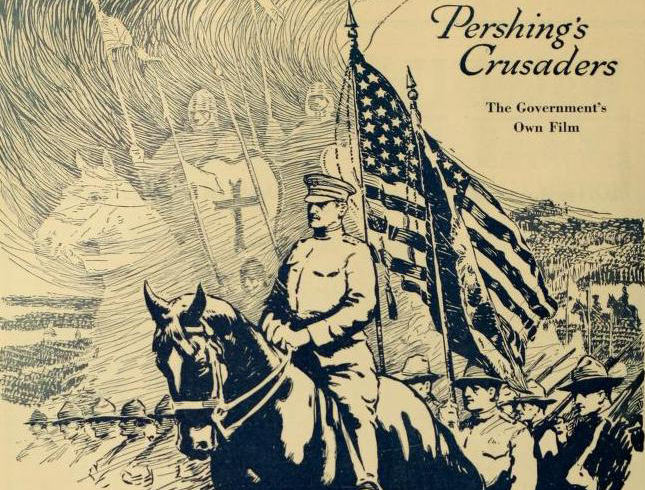
The Committee on Public Information (CPI) had two primary responsibilities: to manage and clear for dissemination all information outside of military channels and to the public on the United States involvement in the war in Europe, and to sell the American population on the war. In two weeks after the establishment of the CPI, George Creel had reached out to his media contacts, establishing contact with newspaper owners and editors across the nation to get them to sign agreements with the CPI to clear all internally generated stories. Many of the owners and editors were skeptical about the “article clearance” being just another form of censorship, and they weren’t sure that the CPI could serve so many outlets. By the end of May, a large majority of newspapers had signed the agreement, and the CPI was generating hundreds of articles per day. As the CPI expanded in the weeks to come, it established regional offices around the country to clear articles, provide pre-cleared articles, and generate pre-cleared articles of local and regional interest. In just a couple of months, the CPI was generating thousands of articles a day. They were so successful that the CPI’s scope was expanded on September 25, 1917, to establish divisions for pictures, films, and other publications.
Early in the CPI’s existence, it was outputting thousands of columns of news per day, and it was by far the largest news organization in the country. The content it produced was for the end consumers of news, the American people. It could have become a state-run news organization, which was recognized by the media moguls and small paper owners of the day. They had a few options, but the only option that would not negatively affect their bottom line was to work with the CPI. CPI provided massive amounts of content that could effectively go straight to typesetting. They also had a large variety of topics to choose from. A paper could produce an entire issue from CPI-generated columns alone. Most papers continued to generate content internally, but the volume was considerably reduced, subsequently reducing newsroom costs, all while increasing circulation to wartime readers. Most businesses that bought ad space continued to advertise, though they tended to lean towards patriotic themes in their advertising. After the war, the CPI was abolished in August 1919. At this time, the Associated Press, which was founded in 1846, took its pre-CPI place as the largest news gathering organization in America.
Sources
- Axelrod, Alan. Selling the Great War: The Making of American Propaganda. Palgrave Macmillan, 2009.
- Creel, George. How We Advertised America: The First Telling of the Amazing Story of the Committee on Public Information That Carried the Gospel of Americanism to Every Corner of the Globe. Harper & Brothers, 1920.
- Creel, George. Rebel at Large: Recollections of Fifty Crowded Years. G.P. Putnam’s Sons, 1947.
- Kingsbury, Celia Malone. For Home and Country: World War I Propaganda on the Home Front. University of Nebraska Press, 2010.
- Schudson, Michael. Discovering the News: A Social History of American Newspapers. Basic Books, 1978.
- Smythe, Ted Curtis. The Gilded Age Press, 1865-1900. Praeger, 2003.